American Gothic
A farmer holding a pitchfork and a woman beside him stand in front of a house with a pointed Gothic window: the most parodied American painting. Full commentary ↓
Couldn't load the puzzle image.
Turn on piece outlines to see piece positions on this picture too
Drag the pieces into place · When zoomed in, drag an empty spot to move around
You can also play with a keyboard — Tab to the board, thenSpace pick a piece, Arrow keys move it (with Shift for small steps),Esc deselect, R rotate a piece (Shift+R the other way)
American Gothic is an oil painting by Grant Wood (1930) in the collection of The Art Institute of Chicago. It measures 78 × 65.3 cm.
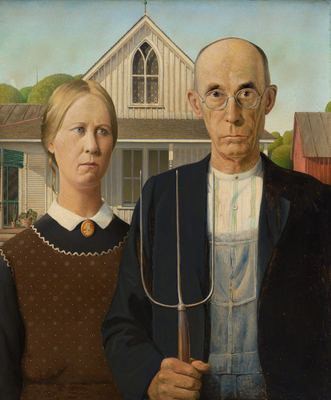
In the pictureA man in glasses holds a three-pronged pitchfork upright and looks straight ahead. The woman beside him looks off to the side, her hair neatly pulled back. The man wears overalls and a black jacket; the woman, a brown apron and a cameo brooch. Behind them is a white clapboard house whose second-floor window is pointed in the Gothic style, like a church window. The three prongs of the pitchfork are echoed in the man's overalls and in the lines of the window.
BackgroundIn 1930, the Iowa painter Grant Wood painted it after seeing a house in Eldon, in his home state. The models were the painter's sister and his dentist, and Wood explained that the two were playing not husband and wife but father and daughter. That year it won a bronze medal at an exhibition at the Art Institute of Chicago, and the museum bought the painting. Americans during the Great Depression took it as a portrait of themselves, and it has been parodied countless times since. Because it was first shown in 1930, it entered the public domain in the United States in 2026.
Puzzle tipStart with the two faces, the pitchfork and the Gothic window. The colors divide into the man's black jacket, the woman's brown apron, the white house and the green trees. The lines of the house's clapboards indicate vertical position. The background sky is a single pale blue, so leave it for last.
- Classification
- Painting
- Medium
- Oil on beaverboard
- Dimensions
- 78 × 65.3 cm
- Credit line
- The Art Institute of Chicago, 1930.934
Source: The Art Institute of Chicago ↗
In these collections: Masterpieces Everyone Knows
Stories about this work
- 17 Must-See Paintings at the Art Institute of Chicago, from Seurat's Dots to American Gothic
Seurat's A Sunday on La Grande Jatte, Caillebotte's Paris Street; Rainy Day, Van Gogh's The Bedroom and Grant Wood's American Gothic. The stories of 17 must-see paintings at the Art Institute of Chicago, what to check before you go, and how to meet them first as puzzles.