17 Must-See Paintings at the Art Institute of Chicago, from Seurat's Dots to American Gothic
Published
The Art Institute of Chicago, on Michigan Avenue in Chicago, was founded in 1879. The two bronze lions on either side of the front steps are the face of the museum. Its collection covers a wide range, but what travelers seek out most are the Impressionist and Post-Impressionist paintings. Chicago collectors bought new paintings from Paris early on, and those paintings came into the museum.
The Art Institute of Chicago releases images of its public domain works under CC0. Seventeen of them are on this site as puzzles, and they can all be seen together in the Art Institute of Chicago collection.
| Work | Artist | Date | Size (cm) |
|---|---|---|---|
| A Sunday on La Grande Jatte | Georges Seurat | 1884–86 | 207.5 × 308.1 |
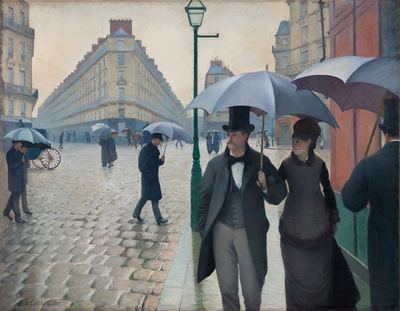
| Paris Street; Rainy Day | Gustave Caillebotte | 1877 | 212.2 × 276.2 |
| Arrival of the Normandy Train, Gare Saint-Lazare | Claude Monet | 1877 | 59.6 × 80.2 |
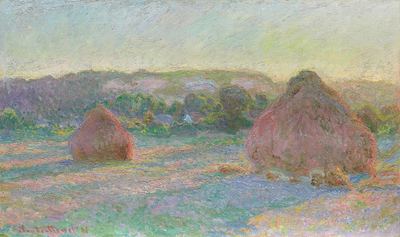
| Stacks of Wheat (End of Summer) | Claude Monet | 1890–91 | 60 × 100.5 |
| Water Lily Pond | Claude Monet | 1900 | 89.8 × 101 |
| Two Sisters (On the Terrace) | Pierre-Auguste Renoir | 1881 | 100.5 × 81 |
| The Millinery Shop | Edgar Degas | 1879–86 | 100 × 110.7 |
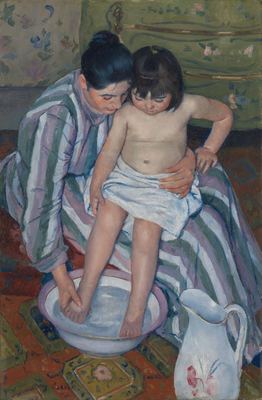
| The Child’s Bath | Mary Cassatt | 1893 | 100.3 × 66.1 |
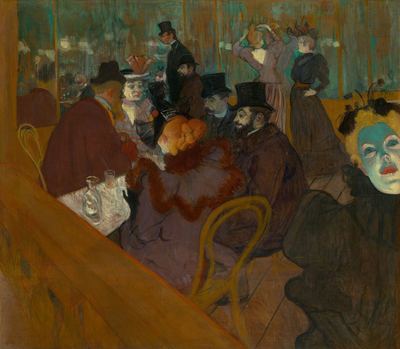
| At the Moulin Rouge | Henri de Toulouse-Lautrec | 1892–95 | 123 × 141 |
| Self-Portrait | Vincent van Gogh | 1887 | 41 × 32.5 |
| The Bedroom | Vincent van Gogh | 1889 | 73.6 × 92.3 |
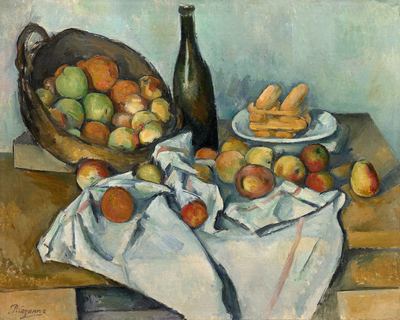
| The Basket of Apples | Paul Cézanne | c. 1893 | 65 × 80 |
| No te aha oe riri (Why Are You Angry?) | Paul Gauguin | 1896 | 95.3 × 130.5 |
| The Herring Net | Winslow Homer | 1885 | 76.5 × 122.9 |
| American Gothic | Grant Wood | 1930 | 78 × 65.3 |
| Old Man with a Gold Chain | Rembrandt | 1631 | 83.1 × 75.7 |
| The Assumption of the Virgin | El Greco | 1577–79 | 403.2 × 211.8 |
Two paintings about three meters wide
 Solve this painting as a puzzle → about 5 minutes on Easy
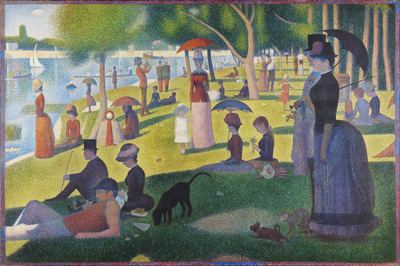
The painting most people look for first at the Art Institute of Chicago is usually Seurat’s A Sunday on La Grande Jatte. It shows Parisians spending a Sunday afternoon on an island in the Seine, painted entirely in small dots of pure color. It is the first painting to try, on a large scale, the method of placing colors side by side instead of mixing them on the palette, so that they mix in the viewer’s eye. When it was hung at the last Impressionist exhibition in 1886, it was ridiculed. Up close you see the dots, and a few steps back the people appear. This painting is best seen from both distances.
Turned into a puzzle, those dots become a headache. Because dots of pure color are scattered evenly across the whole surface, sorting by color does not work well. Set up the large shapes first, such as the dark outlines of the figures, the parasols and the blue band of the river, then fill in the dots between them.
A few years earlier, Caillebotte painted the same city in the opposite way in Paris Street; Rainy Day. He cropped an intersection of the new boulevards laid out by Baron Haussmann, with people under umbrellas, as if it were a photograph. If Seurat painted the air with dots, Caillebotte painted the reflections on the wet paving stones with precision. The two paintings are more than 3 meters and 2.7 meters wide, respectively.
Monet’s series and his Impressionist friends
Monet painted the same subject many times, changing the hour and the season. The three works on this site show three stages of that approach: Arrival of the Normandy Train, Gare Saint-Lazare, which painted steam and light inside the station in 1877; Stacks of Wheat (End of Summer), a late-summer evening from a series of more than twenty-five paintings; and Water Lily Pond, the pond he dug himself in his garden at Giverny. The Art Institute of Chicago has six paintings from the Stacks of Wheat series alone.
Renoir’s Two Sisters (On the Terrace), Degas’s The Millinery Shop and Cassatt’s The Child’s Bath are also paintings of Paris from the same period. After seeing an exhibition of Japanese prints in Paris in 1890, Cassatt took up high viewpoints and flat patterns, and The Child’s Bath is the result. In Lautrec’s At the Moulin Rouge, the painter himself appears as the short man passing by in the background.
Van Gogh’s room, Cézanne’s apples, Gauguin’s Tahiti
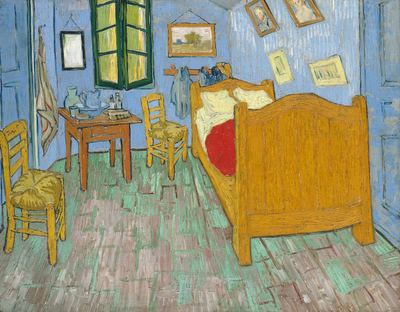
Van Gogh’s The Bedroom depicts his bedroom in the Yellow House in Arles. The first version, painted in 1888, is at the Van Gogh Museum in Amsterdam, and the Chicago painting is the second version, painted again in Saint-Rémy the following year. Van Gogh wrote to his brother that the painting expresses “rest or sleep.” Its blocks of color are distinct, so it is a good first puzzle among the 17. There is also a Self-Portrait from his Paris years, which stretches Seurat’s dots into short strokes, so it is fun to think of it alongside La Grande Jatte.
In Cézanne’s The Basket of Apples, the wine bottle tilts and the edges of the table do not line up. This is the result of choosing the angle from which each object is best seen and recomposing them, and it is regarded as having influenced the Cubism that followed. Gauguin’s No te aha oe riri (Why Are You Angry?) was painted on coarse jute cloth in 1896, during his second stay in Tahiti.
The face of America: American Gothic and Homer’s sea
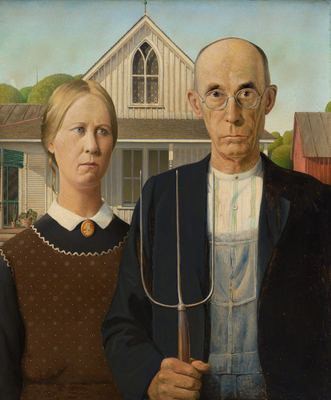
Grant Wood’s American Gothic is counted as the most parodied American painting. It won a bronze medal at an Art Institute of Chicago exhibition in 1930, and the museum bought it. The painter explained that the man holding the pitchfork and the woman are not husband and wife but are playing a father and daughter. Because it was published in 1930, it entered the public domain in the United States in 2026, which made it possible to turn it into a puzzle. Like The Bedroom, its colors divide into large areas, so the pieces fit together easily. Winslow Homer’s The Herring Net, painted on the coast of Maine, is his signature work about fishermen working on rough seas.
There are also paintings by old masters: Old Man with a Gold Chain, a figure study by the twenty-five-year-old Rembrandt, and The Assumption of the Virgin, the first major work El Greco was commissioned to paint after moving to Spain. The Assumption of the Virgin is 4 meters tall.
What to check before you go
Many of the Art Institute of Chicago’s signature works are 20th-century paintings, such as Edward Hopper’s Nighthawks, but paintings still under copyright are not on this site. A work you want to see may be on loan or may have moved to a different gallery, so it is a good idea to check whether it is on view on its object page on the museum’s website before you go. If you are heading to another city, the signature works of The Metropolitan Museum of Art and the Rijksmuseum have been selected in the same way.
In Seurat’s painting, the people appear only when you step back a few paces, but a puzzle goes in the opposite order. Only after you have stared for a long time at pieces holding a few dots does the island on a Sunday afternoon rise up all at once.
Frequently asked questions
Which paintings should I not miss at the Art Institute of Chicago?
Widely known ones include Seurat's A Sunday on La Grande Jatte, Caillebotte's Paris Street; Rainy Day, Van Gogh's The Bedroom, Grant Wood's American Gothic and Monet's Stacks of Wheat series. Edward Hopper's Nighthawks is also famous, but it is still under copyright, so it is not on this site.
Are the two people in American Gothic a married couple?
The painter, Grant Wood, explained that the two are not husband and wife but are playing a father and daughter. The models were the painter's sister and a dentist.
Is The Bedroom at the Art Institute of Chicago the first version Van Gogh painted?
No. The first painting, made in Arles in October 1888, is at the Van Gogh Museum in Amsterdam, and the Chicago painting is the second version, painted again in Saint-Rémy in September of the following year. The third is at the Musée d'Orsay in Paris.