Biretta
An 18th-century biretta, a Catholic clergy hat with red silk blades rising from a square base; it was donated together with a pileus. Full commentary ↓
Couldn't load the puzzle image.
Turn on piece outlines to see piece positions on this picture too
Drag the pieces into place · When zoomed in, drag an empty spot to move around
You can also play with a keyboard — Tab to the board, thenSpace pick a piece, Arrow keys move it (with Shift for small steps),Esc deselect, R rotate a piece (Shift+R the other way)
Biretta is a textile by an unknown maker (18th century) in the collection of The Metropolitan Museum of Art.
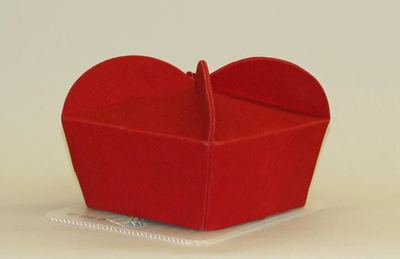
In the pictureAgainst a beige background, a red silk hat sits at an angle on a clear stand. Semicircular blades rise from the square base; from this angle, two rounded blades at the sides and one blade standing upright in the middle can be seen. At the top there is only a small loop, with no tassel or other ornament. Fine grain on the silk surface and fold lines at the corners are visible, and a small label shows through beneath the stand. Unlike the rounded pileus, it is a boxlike shape with angular faces and corners. A vertical seam runs at each of the four corners of the base.
BackgroundThe biretta is an angular hat worn by clergy at Mass and in processions: black for priests, purple for bishops, and red for cardinals. It usually has three raised blades, though in some regions it has four, and it is sometimes worn over a small round cap (the zucchetto). The collection record names no wearer; within a group given by Agnes Clarke in 1941, it received the number C.I.41.124.9, right after the red pileus (C.I.41.124.8). All that can be confirmed is that the two were given together by the same person. The date is given only as the 18th century.
Puzzle tipIt is a single red hat with a lot of background, so 24 pieces suits it. The rounded upper edges of the three blades and the angular lower edge of the base are the surest boundaries. Place the upright middle blade first and attach the side blades, then tell the front face of the square base from the side face by the fold lines at the corners. The small loop at the top is the point where the three blades meet. Place the white pieces of the clear stand below, then fill in the background. The background pieces along the edges are slightly lighter at the top than at the bottom.
- Classification
- Textiles-Woven
- Medium
- Silk
- Credit line
- Gift of Miss Agnes Clarke, 1941
Source: The Metropolitan Museum of Art ↗
Stories about this work
- From a Cardinal's Red Cap to a Palestinian Headscarf: Things Worn on the Head
Hats that signal authority, headdresses that tell you a region, a headscarf covered in embroidery. Six pieces of headwear we had never covered before, gathered in one place.
Puzzles to try next
More European Embroidery & Costume puzzles· Stories and puzzle tips