From a Cardinal's Red Cap to a Palestinian Headscarf: Things Worn on the Head
Published · updated
There is a round cap pieced together from red leather, and next to it a headdress of cream fabric pleated like a fan. We have introduced quite a few clothing puzzles, but we had never gathered the things people wear on their heads. From a cardinal’s red cap to a Palestinian embroidered headscarf, here are six pieces.
| Work | What it is | Material |
|---|---|---|
| Pileus | A cardinal’s round cap | Leather |
| Biretta | A cardinal’s square cap | Silk |
| Oorijzer | A Dutch woman’s head frame | Gold, pearls |
| Hat | A European regional ceremonial hat | Silk, metallic thread, linen |
| Headdress | A European countrywoman’s fan-shaped headdress | Cotton, metal |
| Headscarf | A Palestinian embroidered headscarf (19th century) | Linen, silk |
Two caps of one cardinal
 Solve this painting as a puzzle → about 5 minutes on Easy
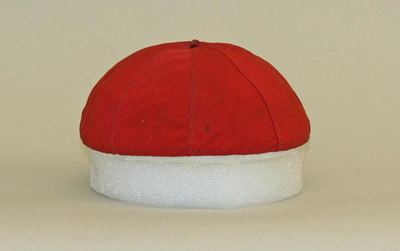
The Pileus is a round cap made of red leather. Six pieces of leather are joined into a hemisphere with a small knob on top, and that is all; there is no decoration. The name comes from a brimless cap of ancient Rome. Today it refers to the small cap worn by Catholic clergy, and only cardinals may wear red. Leather examples are rare, so it may have been for travel or everyday use.
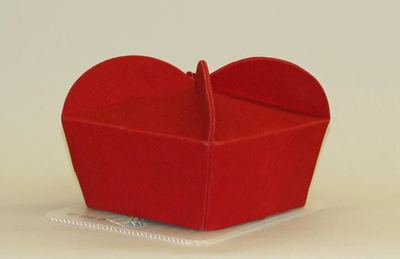
The Biretta is another cap that came in with the same collection. Three ridges rise from a square base and meet in the middle, and it is made of red silk. Priests wear black birettas, bishops purple, and cardinals red. Three ridges mean the Roman style; in some regions there are four. Records show that both caps were given in 1941 by a woman named Agnes Clarke, so they are thought to have belonged to a single cardinal. The formality of the liturgy and the practicality of the road sat side by side in one person’s luggage.
Headdresses that told you which village someone came from
The other four are headdresses worn by women in Europe and West Asia. They have one thing in common: their shape and pattern alone told you where the wearer came from.
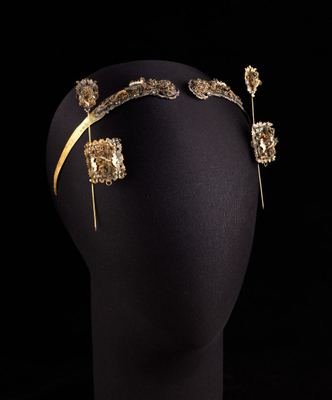
The Oorijzer decorative coif frame takes its name from the Dutch oorijzer, meaning “ear iron.” It is a thin gold band worn around the head, with square ornamental plates at each temple. At first it was an iron band that held a white lace cap in place, but as households grew more prosperous it changed to silver and gold. The plates at either end, visible outside the cap, showed both where a woman lived and how wealthy she was, and they are said to have become especially elaborate in the provinces of Zeeland and Friesland in the mid-19th century.
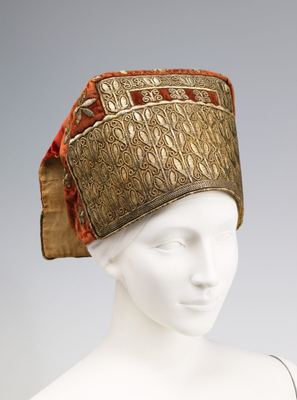
The Hat is a tall cylinder of red silk densely trimmed with metallic lace. It was worn at weddings and festivals in many parts of Europe in the late 18th century, and its shape differed slightly from region to region, so it alone could tell you where someone was from. Metallic lace was expensive, so hats like this were handed down through generations.
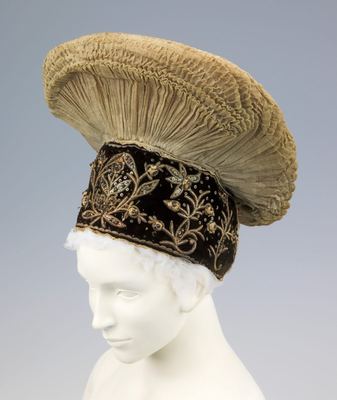
The most dramatic silhouette of the six belongs to the Headdress. Above a black velvet band embroidered with flowers in gold thread and beads, cream fabric is finely pleated and spread wide like a fan. This style appears in women’s folk dress in many parts of 19th-century Europe, and the size and direction of the pleats differed from village to village. It had to be starched and ironed, which took a great deal of work, so it was worn only at festivals.
A headscarf lined with roosters
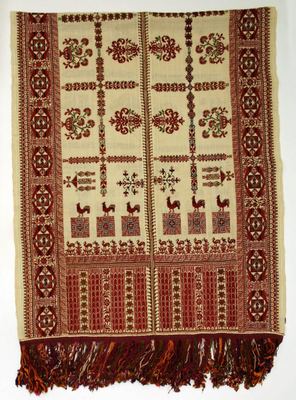
The Headscarf is two widths of cream linen joined down the middle and embroidered mainly in red thread. In the upper register, flowers in vases and branching trees sit between cross-shaped bands. Below them, roosters standing on square bases line up three to each width, and at the very bottom there is a band of vertical stripes and thick tassels. The Met’s record gives the place of manufacture as Palestine and the date as the 19th century, and the whole piece is a full 231.8 centimeters long. The photograph appears to show one tasseled end of this long cloth. When it is wrapped on the body, the embroidery and tassels are concentrated on the hanging end.
Set the six side by side and the contrast is sharp. The clergy’s caps followed fixed colors and shapes that indicated rank. The women’s headdresses mapped something much finer-grained and more personal than rules: village and region. They are all things worn on the head, yet the kind of information they carry is very different.
Work from outlines and corners
Most of the backgrounds are simple, so the shape of the object is your best clue. The pileus and biretta are objects set against a white background, so start with their outlines; on the biretta, the point where the three ridges meet is a sure reference point. For the oorijzer, find the curve of the gold band and the two plates first, then fill in the details with the pieces showing pearl pins.
For densely patterned pieces like the hat and the headdress, it is better to sort roughly by the shimmer of the metallic lace or the colors of the velvet embroidery and then narrow down. The headscarf repeats its flowers, trees, and roosters from side to side, so, as covered in Why repeating patterns are hard, it is faster to look first for shape clues such as the tassels or the border rather than the pattern. Easy (about 24 pieces) is plenty for the small pileus and biretta, and Normal (about 48) suits the other four with their busy patterns.
There was a time when a single hat or headscarf told you the wearer’s status, home village, and even whether they were married. The same thing seen in The story of an embroidered sampler and Syrian dress, village by village was happening on top of people’s heads as well. The hats we wear today do not say nearly as much. That is a little regrettable.