Blouse
A late 19th-century Eastern European woman's blouse of white cotton, its wide sleeves and front embroidered with glass beads; red bands on the shoulders stand out. Full commentary ↓
Couldn't load the puzzle image.
Turn on piece outlines to see piece positions on this picture too
Drag the pieces into place · When zoomed in, drag an empty spot to move around
You can also play with a keyboard — Tab to the board, thenSpace pick a piece, Arrow keys move it (with Shift for small steps),Esc deselect, R rotate a piece (Shift+R the other way)
Blouse is a textile by an unknown maker (fourth quarter 19th century) in the collection of The Metropolitan Museum of Art. It measures 53.3 cm.
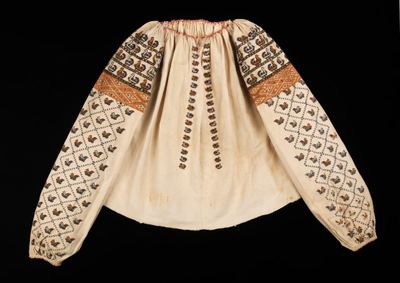
In the pictureA white cotton blouse is spread out on a black background. Small glass beads are set in a grid of floral motifs across the entire wide, flaring sleeves, a red embroidered band runs across the shoulders, and a beaded pattern also runs down the center of the front. The neckline is gathered in.
BackgroundA white blouse with decoration concentrated on the sleeves and shoulders is the basic form of women's folk dress in Eastern Europe, including Romania, Ukraine and Hungary. Glass-bead embroidery entered rural needlework in the late 19th century, when beads became cheaply available in towns; it is heavier than thread embroidery but reflects light, which suited festive dress.
Puzzle tipThe beaded pattern repeats in a grid, which makes positions hard to pin down. Fit the red shoulder bands, the gathered neckline and the outline pieces at the ends of the sleeves first, and use the density of the beadwork to tell sleeve pieces from front pieces. Fill in the black background pieces last. 48 pieces is recommended.
- Classification
- Main dress-Womenswear
- Medium
- cotton, glass
- Dimensions
- 53.3 cm
- Credit line
- Brooklyn Museum Costume Collection at The Metropolitan Museum of Art, Gift of the Brooklyn Museum, 2009; Brooklyn Museum Collection
Source: The Metropolitan Museum of Art ↗
Stories about this work
- Five Embroidered Eastern European Garments, From Leather Coat to Beaded Blouse
From a fur-trimmed, aristocratic-style overcoat to a blouse embroidered with glass beads. Five embroidered Eastern European garments, each from a different country and in different materials, gathered in one place.
Puzzles to try next
More European Embroidery & Costume puzzles· Stories and puzzle tips