Five Embroidered Eastern European Garments, From Leather Coat to Beaded Blouse
Published
There is a coat made of sheepskin turned so the fleece is inside, its outer surface densely embroidered with flowers. Garments from the same Eastern Europe also include an aristocratic-style overcoat of velvet with gold-thread buttons, and a blouse with glass beads set all over its sleeves. Even within one region, the materials and forms of clothing differed this much. Here we set side by side five pieces from different countries and different social classes.
| Work | Material | Date |
|---|---|---|
| Coat | Leather | 1900 |
| Costume | Silk, fur, cotton, wool, leather, metal thread | 1850–1900 |
| Blouse | Cotton, glass | Late 19th century |
| Dress | Linen, silk, metal | Late 19th century |
| Vest | Leather, wool, cotton | Late 19th century |
A sheepskin coat brought out for weddings
 Solve this painting as a puzzle → about 5 minutes on Easy
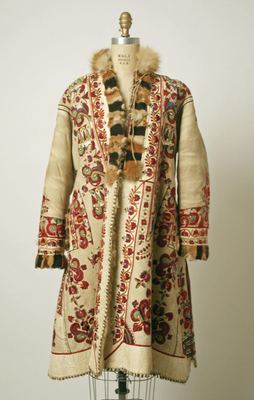
The cream leather of the Coat is crowded with flowers and leaves in red, green, and black thread. Brown fur trims the neckline, the front opening, and the cuffs. Sheepskin coats like this, with the fleece inside and embroidery on the outer surface, were worn as formal winter wear in the Eastern European countryside, in places like Hungary, Romania, and Ukraine. How densely a coat was embroidered revealed a household’s means, and the bride and groom sometimes wore them at weddings. Made in 1900, this one dates from the time when the tradition was at its most lavish.
In the puzzle, the red embroidery, cream leather, and brown fur separate clearly. Run the outline of the garment first with the fur trim, then connect the embroidery by following the direction the floral patterns extend. 100 pieces is right.
A costume borrowed from aristocratic dress
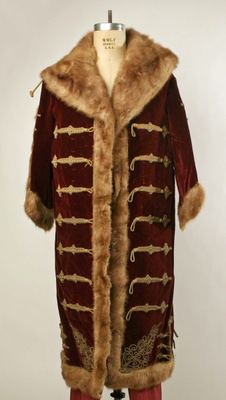
The Costume is a long overcoat of deep purple velvet trimmed with fur, with six rows of gold-thread knotted buttons across the chest. An outfit combining velvet, fur, and knotted buttons came from the traditional formal dress of the Polish, Hungarian, and Russian nobility. In late 19th-century Europe, such garments were sometimes made specially to wear at masquerade balls or on stage. The list of materials includes silk, fur, cotton, linen, wool, leather, and metal thread, which means each part was made of a different material. Its starting point is different from the embroidered clothes of the countryside. It is a garment in which the city dressed itself in borrowed images of the countryside and the court.
When assembling, the purple velvet, brown fur, and gold buttons divide by color. Set the outline with the fur trim, line up the gold knotted buttons on the chest, and then fill in the velvet while watching the direction its sheen flows. Between 48 and 100 pieces is right.
Glass beads instead of thread
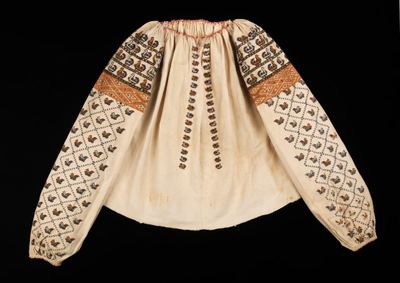
The Blouse has floral patterns set in a grid of small glass beads across its entire wide, flaring sleeves. A band of red embroidery runs around the shoulders. A white blouse with its decoration concentrated on the sleeves and shoulders is the basic form of women’s folk dress in Eastern Europe, including Romania, Ukraine, and Hungary. Glass beads entered that form in the late 19th century, once beads were cheaply supplied from the cities. They are heavier than thread embroidery, but they reflect light, which suited festival clothes. It is a case of an old form taking in a new material.
Because the pattern on this blouse repeats in a grid, placing pieces is tricky. Start with the red band at the shoulders, the gathers at the neckline, and the outline of the cuffs, then sort the bead pieces into sleeves and front by how dense the pattern is. We recommend 48 pieces.
A hem that hides under outer garments
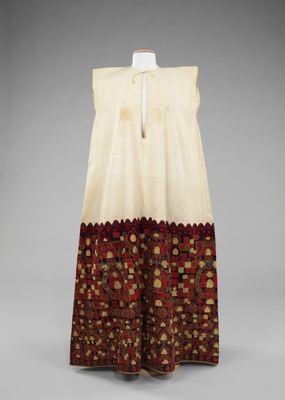
The upper part of the Dress is plain cream linen. Only from the knee down to the hem is it dense with red, gold, and black geometric patterns. Filling only the hem of a sleeveless linen dress with embroidery is the form of a garment women in Greece and the Balkans wore as both underdress and dress. With a vest and apron layered on top, only the embroidery at the hem shows. The patterns and colors told you which village a woman came from and whether she was married, and such garments were made over several years as part of a trousseau.
The cream above and the embroidery below divide sharply, so start with the pieces along the zigzag boundary between them. 48 pieces is right.
A vest by a village leatherworker
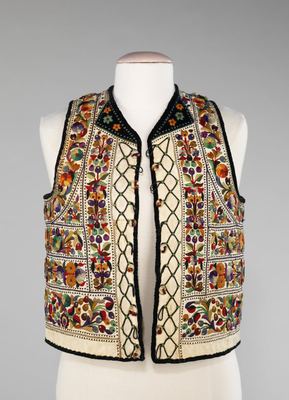
The Vest is embroidered all over its cream leather ground with flowers, leaves, and birds in red, yellow, green, and blue thread, in left-right symmetry, with black fur set along the front opening and neckline. Embroidering many-colored flowers on a sheepskin vest is a practice found in the festival clothes of the Slovak, Moravian, and Hungarian countryside. A village leatherworker made them to set designs, and the color and density of the embroidery set one village apart from another. Young men and women wore them at weddings and festivals.
It is mostly embroidery, but the colors are varied, so comparing with the preview quickly fixes positions. It is symmetrical, so once you assemble one side, the other follows. 100 pieces is right.
“Eastern European embroidery” is a broad term
Hang the five side by side and you feel how broad the term “Eastern European embroidery” is. There is a fur coat from a country wedding, and a city velvet garment imitating the nobility. There is also a blouse that took in a new material, glass beads, a dress that hides under outer garments, and a vest from the hands of a village craftsman. Even in the same region, the face of a garment changed this much depending on who used it for what.
The story of leather garments continues in Hungarian shepherds’ winter clothes and its second part, and outfits worn in many layers can be seen in Layered European women’s folk dress. Looking at these garments brings to mind a time when a pattern was an identity card. There were people who could tell, from the color and density of the embroidery alone, which village someone came from, how well off they were, and whether they were married.