Choga
A lavish Indian coat of crimson velvet embroidered with gold thread and sequins, a late 19th-century choga with gold bands edging the front and sleeves. Full commentary ↓
Couldn't load the puzzle image.
Turn on piece outlines to see piece positions on this picture too
Drag the pieces into place · When zoomed in, drag an empty spot to move around
You can also play with a keyboard — Tab to the board, thenSpace pick a piece, Arrow keys move it (with Shift for small steps),Esc deselect, R rotate a piece (Shift+R the other way)
Choga is a textile by an unknown maker (late 19th century) in the collection of The Metropolitan Museum of Art. It measures 119.4 cm.
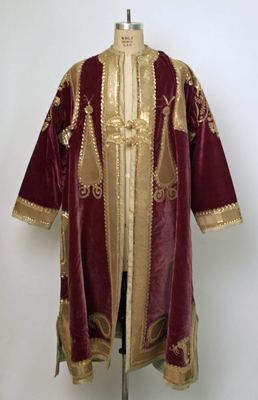
In the pictureA long coat of crimson velvet is dressed on a mannequin. Bands of gold thread run along the front opening, neckline, cuffs, hem and side slits, and large paisley motifs embroidered in gold thread and sequins are scattered over the body and sleeves. The front is open, and the lining shows slightly.
BackgroundA choga of velvet with gold-thread embroidery was among the finest garments worn at Indian courts for ceremonies and audiences. The paisley (mango-shaped) motif began in Kashmir and spread throughout India, and glittering bits of metal were sewn in with it so that it shone in candlelight. The velvet may have been imported from Europe.
Puzzle tipThe crimson velvet, gold bands and paisley motifs separate by color and shape. Outline the garment first with the gold band pieces, place the paisley pieces by comparing them with the preview, then fill in the crimson pieces by the direction of the velvet's sheen. 100 pieces is about right.
- Classification
- Main dress-Menswear
- Medium
- Silk, metal wrapped thread, sequins; embroidered
- Dimensions
- 119.4 cm
- Credit line
- Purchase, Irene Lewisohn Bequest, 1952
Source: The Metropolitan Museum of Art ↗
Stories about this work
- Angarkha, Choga, and Kurta: Embroidery and Weaving in Indian Menswear
The kurta is a long shirt worn across South Asia, the angarkha a robe that fastens diagonally across the chest, the choga a loose open-front robe. Nine 18th–19th century garments at the Met show the differences and the embroidery.