Angarkha, Choga, and Kurta: Embroidery and Weaving in Indian Menswear
Published · updated
Small pieces of mirror are set closely into a green silk chest panel, glinting like silver dots. Besides West Asian clothing, the Islamic Art section holds several garments with unfamiliar names from South Asia: Indian men’s clothes. There are two angarkhas, four chogas, and three kurtas. All were photographed on mannequins, and most date from the 18th and 19th centuries.
The museum’s records give only the type of garment, the materials, and an approximate date. What follows starts from those records.
How do the angarkha, choga, and kurta differ?
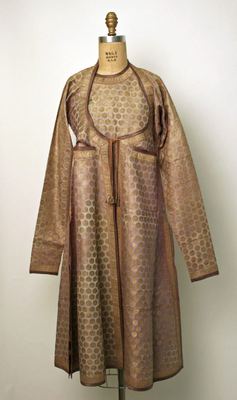
The angarkha is an outer robe worn by men in northern and western India. Its name comes from its construction, which fastens across the chest on a diagonal or curve; the front is cut in a rounded opening that shows the garment underneath, and the sleeves are long and narrow.
The choga is a loose garment that men in India and Persia wore over their other clothes. The front is open and the sleeves flare wide.
The kurta is a long shirt worn everywhere in South Asia. The embroidery on the chest panel sets the garment’s level of refinement.
| Work | Date | Features |
|---|---|---|
| Angarkha | 18th century | Quilted white cotton, no pattern |
| Choga | Late 18th–early 19th century | Tawny wool, bands of red floral embroidery |
| Angarkha | 19th century | Silk woven with metallic thread, roundel pattern |
| Choga | Late 19th century | Purplish silk, woven with gold thread |
| Choga | Late 19th century | Crimson velvet, gold thread and sequin embroidery |
| Choga | Late 19th century | Navy velvet, gold thread floral embroidery |
| Kurta | 19th century | Green silk, mirror embroidery |
Only one of the three kurtas is in the table; the other two (86186, 86187) are also on the site.
Woven in, embroidered on, set in
Lay the garment types, materials, and patterns side by side, and the ways of adding pattern fall into roughly three paths.
 Solve this painting as a puzzle → about 5 minutes on Easy
One is weaving it in. In the gold-woven choga and the roundel-patterned angarkha, the pattern went in when the cloth was woven on the loom. A woven pattern like this reflects light evenly across the whole garment.
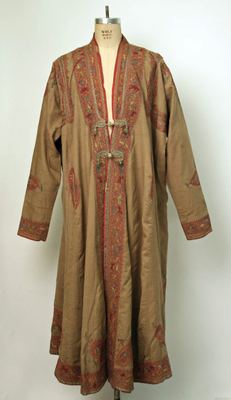
Embroidery was also added on top of finished cloth. The velvet chogas and the Kashmir-style wool choga are examples.
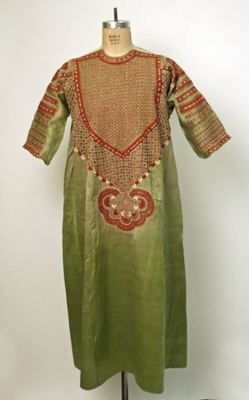
In the kurta, small pieces of mirror are held in place and set in with embroidery. This is a traditional technique of western India and the Sindh region of Pakistan.
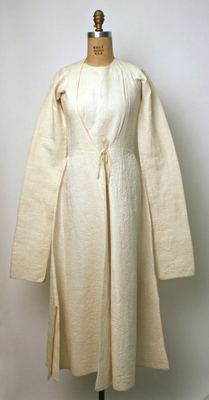
The materials also hint at season and status. The wool choga is winter wear, and the quilted cotton angarkha seems to have been worn in cool seasons or in the early morning. Silk with metallic thread and velvet embroidery were worn at court or at ceremonies. The white angarkha, which achieves its refinement through quilting alone without a single pattern, is closer to the kind of garment scholars and officials favored.
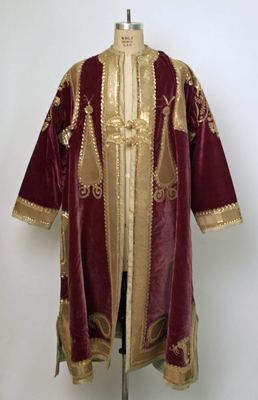
A European shadow falls on them, too. The pockets and folded collar of the navy velvet choga appear to be traces of late-19th-century Indian aristocrats adopting the shape of the European jacket, and the velvet of the crimson choga may itself have been imported from Europe. These are only guesses, so do not read them as established fact.
Mirrors are easy, gold weaving is hard
The difficulty of the puzzle changes dramatically with the pattern.
On the mirror kurta, the glints are your guide. From a distance, the embroidered panel with mirrors set in a grid looks like a pattern of silver dots. The embroidered panel is at the upper chest, the red floral decoration below the chest, and plain silk at the hem, so the garment’s vertical structure itself tells you where pieces go.
The gold-woven choga is the opposite and gives you trouble. The pattern spreads evenly over the whole garment, so the pieces resemble each other. As covered in Why repeating patterns are hard, you have to find small differences within the repetition, but it is better to use shape clues first: the mannequin’s outline, the shadows in the folds of the sleeves, the opening of the skirt.
For the velvet chogas, follow the edge bands. The crimson and navy chogas have bands of gold thread around the front opening, neckline, cuffs, and hem. Gather the band pieces first to build the silhouette, then fill in the body later. Against dark velvet, the gold pieces separate easily, so for patterned garments they are fairly easy to solve.
The trickiest is the white quilted angarkha. The only color is white, and the quilting lines create just a little texture. Divide it by the shape of the mannequin and the shadows of the sleeves, and it is better to start with fewer pieces.
For piece count, Normal (about 48 pieces) suits the densely patterned garments, and the velvet chogas and mirror kurta, with clear colors and shapes, are worth trying up to Hard (about 100). Tips for sorting pieces by color are also in How to sort pieces by color.
The workshops of Kashmir and Lucknow
A few garments can be tied to place names. The wool choga uses the same embroidery technique as Kashmir shawls, and gold-woven chogas from the weaving workshops of Kashmir or Lucknow are said to have been especially prized. The paisley pattern, too, began in Kashmir and spread throughout India. But which workshop each garment actually came from cannot be known from the museum’s records alone.
Even the same gold thread was used in quite different ways depending on the country and the period. For European clothing, continue with The toreador’s suit of lights and The story of an embroidered sampler. Part of the pleasure of these garments is that woven gold thread, embroidered gold thread, and thread holding mirrors are all gathered in one section. There are few better specimens than clothing puzzles for looking closely at how stitch-by-stitch thread catches the light.
Frequently asked questions
What is a kurta?
It is a long shirt worn widely across South Asia, including India and Pakistan. The 19th-century kurta at The Metropolitan Museum of Art discussed in this post has a green silk chest panel decorated with small pieces of mirror held in place by embroidery.
How do the kurta, angarkha, and choga differ?
The kurta is a long shirt, the angarkha is a robe that fastens across the chest on a diagonal or curve, and the choga is a loose robe with an open front and wide sleeves. Looking at how each garment fastens and whether the front is open makes them easy to tell apart.