Dress
A dress of sheer black cloth with red lozenge embroidery and inset mirrors, an Indian-style garment collected and sold by Liberty & Co. of London. Full commentary ↓
Couldn't load the puzzle image.
Turn on piece outlines to see piece positions on this picture too
Drag the pieces into place · When zoomed in, drag an empty spot to move around
You can also play with a keyboard — Tab to the board, thenSpace pick a piece, Arrow keys move it (with Shift for small steps),Esc deselect, R rotate a piece (Shift+R the other way)
Dress is a textile by Liberty & Co. (late 18th–early 19th century) in the collection of The Metropolitan Museum of Art.
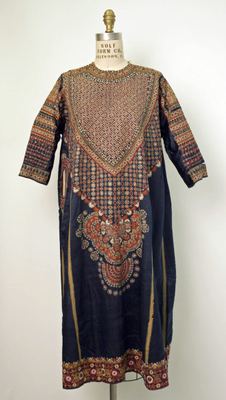
In the pictureA long dress made of thin, sheer black cloth is dressed on a mannequin. On the chest, a panel embroidered with red thread and small pieces of mirror in a lozenge pattern descends in a V, and fine gold lattice patterns are scattered over the whole body. The sleeves are long and narrow.
BackgroundThe garment is catalogued under the name of Liberty & Co. of London. In the late 19th century, Liberty imported textiles and clothing from India and East Asia and sold them to the European upper classes, and garments like this were worn as the "Oriental" at-home dress then fashionable in Europe. Mirror embroidery and lozenge patterns are traditions of western India, but the cut of the garment may have been adapted to European taste.
Puzzle tipThe red lozenge embroidery panel is the most distinct, so assemble it first. The fine lattice pieces on the body are evenly spaced and hard to place, so build a frame from the mannequin's outline and the narrow sleeve shapes, then fill in. 48 pieces is recommended.
- Artist
- British, founded London, 1875
- Classification
- Main dress-Womenswear
- Medium
- Satin; mirror embroidered
- Dimensions
- [no dimensions available]
- Credit line
- Gift of Mr. and Mrs. Clarence Stein, 1962
Source: The Metropolitan Museum of Art ↗
Stories about this work
- How Mirror Embroidery from Western India Made Its Way to a London Shop
An embroidery technique that fixes small pieces of mirror in place with thread. A pair of trousers worn by the people who made it, and a dress sold to the European upper class through a London shop.