How Mirror Embroidery from Western India Made Its Way to a London Shop
Published
Mirrors sewn onto clothing are hard to picture at first. There is an embroidery technique that wraps real pieces of mirror in thread to fix them to cloth. It has a long history in western India and in the Sindh region of present-day Pakistan. Two garments here are made with this technique. One is a pair of trousers actually worn by people of that region, and the other is a dress that reached the European upper class by way of a well-known London shop. The same technique split off along entirely different paths.
| Work | Area | Color |
|---|---|---|
| Dress | Full length | Black cloth with red thread and a gold lattice |
| Trousers | Below the knee | Orange silk with red floral pattern |
Embroidery only below the knee
 Solve this painting as a puzzle → about 5 minutes on Easy
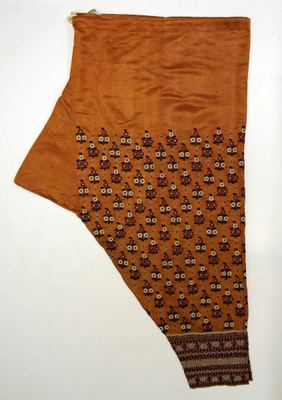
The Trousers are made of orange silk. Spread out one leg and the upper part is plain, unpatterned silk. From the knee down, red floral motifs and small pieces of mirror run close together, and bands of white and red embroidery circle the ankles.
Why decorate only below the knee? Trousers like these were worn under a long upper garment, so when the wearer walked, only the part below the knee showed beneath the hem. No effort was spent on what could not be seen. Since they narrow toward the ankle, the embroidered part would have looked snug against the leg. Orange was a color favored in this region for festivals and weddings.
The boundary between the patterned and plain areas is clear, so in the puzzle, find that line first. Sort the floral motifs and mirror pieces below the knee by their sparkle, and the embroidered bands at the ankles by color contrast.
By way of Liberty & Co.’s display window
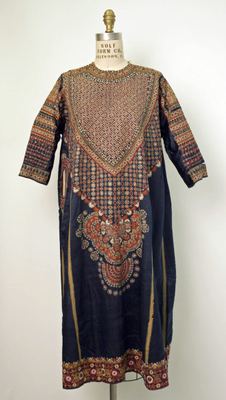
The Dress is made of a thin, sheer black cloth. On the chest, a panel worked with a diamond pattern in red thread and small pieces of mirror descends in a V shape, and a fine gold lattice pattern is scattered across the whole body.
In the collection records, this dress is listed under the name “Liberty & Co.” In the late 19th century, Liberty in London was a shop that imported textiles and clothing from India and East Asia and sold them to the European upper class. At that time, garments like this were popular in Europe as “Oriental-style” indoor wear. The mirror embroidery and diamond pattern follow western Indian tradition exactly, but the cut may have been adjusted to European taste. It is a trace of one region’s technique becoming merchandise and being sold to a distant country.
On the dress, the V-shaped chest panel is the most distinct form, so start there and work outward to the fine lattice on the body. Where the contrast between the black cloth and the gold pattern is weak, you have to rely on the texture and direction of each piece. Both garments have dense embroidery, so something between 48 and 100 pieces is about right.
Clothes for wearing, clothes for selling
Set side by side, the two show how differently the same technique can live. The trousers were made to fit the body of someone who lived in them. Where to decorate and where to leave plain was also decided by the wearer’s needs. The dress was separated from its original use, passed through a shop window, and was reborn to suit the taste of a different culture on a different continent. The mirror pieces sparkle just the same, but what that sparkle means has changed.
We met the embroidery tradition of western India and Sindh once before, in a mirror kurta among Indian men’s robes. Add these two pieces and you can trace the path by which one region’s handcraft passed through men’s and women’s clothing and reached display windows across the border. Read alongside repeating patterns in Islamic art or the story of embroidered samplers, and you can really feel how needle and thread carry stories of geography, class and trade. The same pieces of mirror sparkled at the ankle with every step on one side, and in a London shop window on the other.