Head of a Bearded King
The crowned, bearded face of a king, in reality no bigger than a thumb: a small 14th-century French marble with traces of red paint and gilding. Full commentary ↓
Couldn't load the puzzle image.
Turn on piece outlines to see piece positions on this picture too
Drag the pieces into place · When zoomed in, drag an empty spot to move around
You can also play with a keyboard — Tab to the board, thenSpace pick a piece, Arrow keys move it (with Shift for small steps),Esc deselect, R rotate a piece (Shift+R the other way)
Head of a Bearded King is a stone object by an unknown maker (ca. 14th century) in the collection of The Metropolitan Museum of Art. It measures 6 × 4.3 cm.
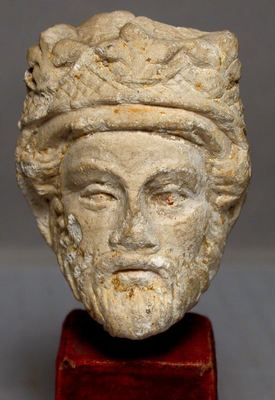
In the pictureA man's head carved in white marble rests on a red base. He wears a crown with floral ornaments and a curly beard; his eyes are wide open and his mouth slightly parted. Traces of red paint and gilding remain between the crown and the hair. Its actual height is only 6 cm.
BackgroundA king's head this small was most likely part of a little sculptural group with several figures, such as an Adoration of the Magi. In 14th-century France, palm-sized religious scenes were made in marble and ivory and kept in the private chapels of nobles, and they were originally finished lavishly with paint and gilding. The white marble is what remains after that paint wore away.
Puzzle tipThe white of the marble is close to the gray of the background, so finding the outline pieces is the key. The pointed ornaments of the crown, the curly pieces of the beard and the red base below have distinct shapes and are good to fit first. Place the plain pieces of the face by the shadows of the eyes, nose and mouth.
- Culture
- French
- Classification
- Sculpture-Stone
- Medium
- White marble, traces of red paint and gilding
- Dimensions
- 6 × 4.3 cm
- Credit line
- Bequest of Nanette B. Kelekian, 2020
Source: The Metropolitan Museum of Art ↗
Stories about this work
- A Story in the Palm of Your Hand: Three Medieval Ivories and Holy Objects
Most medieval art is small. Why it had to be, how to use zoom to read carvings on tiny surfaces while you assemble them, and advice on difficulty.