A Story in the Palm of Your Hand: Three Medieval Ivories and Holy Objects
Published · updated
Just skimming the dimensions in the work information for the Medieval Art category is eye-opening. The smallest is a Byzantine gold coin 1.4 cm across; the largest is a tapestry more than 3 m on a side. Between them, at least eleven works measure less than 10 cm on their longest side. To eyes used to oil paintings that fill a whole wall, that is a surprising scale. The four gold coins have their own post, Byzantine gold coins, so here we look at three pieces made of ivory, copper alloy and marble.
Things to Carry and Wear Around the Neck
The small objects in this category were mostly carried or worn on the body: portable diptychs unfolded for prayer while traveling, reliquary crosses worn around the neck, pyxes held in the hand. The reason they had to be small lay in how they were used.
Being small did not make their content simple.
 Solve this painting as a puzzle → about 5 minutes on Easy
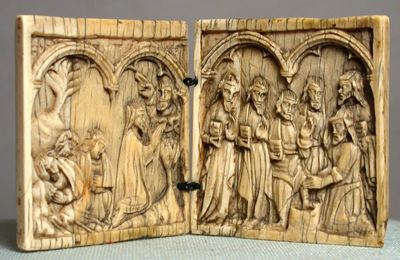
Diptych with Scenes from the Passion was made in 15th-century France from two elephant-ivory plaques joined by iron hinges. The collection record gives its size as 4.1 × 3.9 cm, smaller than the short side of a credit card. Opened, both plaques are carved at the top with the double arches of Gothic architecture, with figures standing beneath. A fingernail-sized ivory plaque imitates a bay of a cathedral. On the left plaque are a figure kneeling under a tree and figures crouching low. On the right plaque several bearded figures stand in a row, and one person kneels at the front right. Each face is estimated at around 5 mm in actual size, yet every one has a distinguishable beard and eyes.
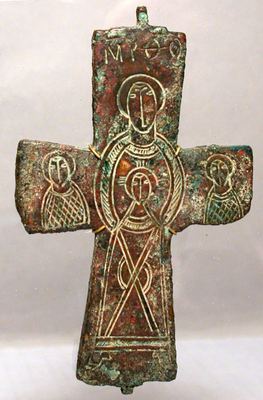
Half of a Pendant Reliquary Cross is an 11th-century Byzantine copper-alloy cross, 9.5 cm high. Two halves of a cross like this fit together to form a hollow box, into which a fragment of a saint’s relic was placed, and it was worn around the neck. A relic means a fragment of a saint’s bones or an object associated with a saint, and wearing one on the body was believed to offer protection. Only half survives now. On the front is an incised Virgin holding the Christ Child in a circle before her chest, and on each arm is a half-length saint in a garment with a grid pattern. The letters at the very top read as Greek.
Zooming In 1.2 Times at a Step, Up to 3 Times
In this category the zoom button really earns its keep. Because the original objects are so small, simply viewing one photograph at full screen already means seeing it far larger than life. Look closely at a single piece and you can make out textures such as the grain of the ivory or the corrosion on the copper surface.
On the puzzle screen, each press of the + button enlarges the view by 1.2 times, up to a maximum of 3 times. After zooming in, drag an empty area to move the view, and use the Reset zoom button to return. When you get stuck, make a habit of zooming in now and then to scan the board.
Ivory Grain, Copper Corrosion, Marble Shadows
Metal and ivory have an even, single-colored surface, so they are about as hard as the pictures with wide solid areas mentioned in the difficulty guide. Still, in medieval works the shadows cast by carving and relief are distinct, so using light and dark as your clue works better than you might expect.
The diptych is entirely yellowish ivory, so color will not solve it. Instead you have the curves of the arches, the two black rings of the central hinge, and fine vertical cracks running along the ivory grain. The cracks run long from top to bottom on both plaques, so match the heights of lines broken off at piece edges. On the cross, the light gray background and the dark copper tone separate clearly, making it easy to clear away the background pieces first. The remaining pieces each show a different pattern of green corrosion spreading over a reddish-brown ground, so those blotches act almost like fingerprints.
It is better to keep the piece count low. The commentary recommends 24–48 pieces for the diptych and the cross, and the “48 pieces” in the difficulty name is laid out to fit each picture’s proportions, as 9 × 6 for the diptych and 6 × 9 for the cross, making 54 pieces. The smaller the object, the fewer the pieces should be for the details to come alive.
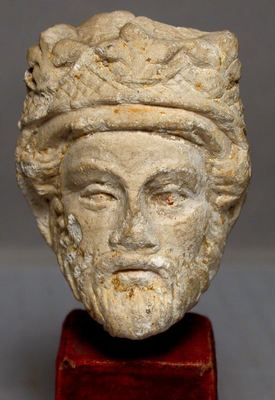
A strongly three-dimensional stone work like Head of a Bearded King is good for practicing this approach. It is a 14th-century French white marble sculpture measuring 6 × 4.3 cm. Given that only the head survives, it may originally have been part of a group of small sculptures forming a scene such as the Adoration of the Magi. The collection record says traces of red paint and gilding remain, and in the photograph too, orange specks can be seen around the face and beard. You can see more medieval sculptures like this, once brightly painted and now stripped of their color, in Imagining Colors That Have Since Vanished.
As a puzzle, the thick band of the crown and the leaf-shaped ornaments above it, the curling beard and the red base below all have distinct shapes and are good to assemble first. Place the plain pieces in the middle of the face by the shadows under the brow and nose. The background is an even gray, so pieces near the four corners cannot be told apart; leave them until the end.
What You Miss Behind Glass
All three entered the museum in 2020 through the bequest of Nanette Kelekian. Five other works from the same bequest can be seen in A Thousand Years Gathered by One Person.
In the galleries, small objects like these are usually displayed several to a glass case, and they are so tiny that visitors find it hard to study them for long. A puzzle is different. To fit the pieces, you have to look into every corner anyway. These small objects are probably where why a puzzle becomes a way of looking at art shows most clearly. The moment you make out the beard carved on a 5 mm face, you feel, just briefly, that your gaze overlaps with that of the person who once carried this object in their hand.