Kurta
An Indian kurta of dark brown silk densely embroidered with grids and circles, anchored by a large embroidered panel running from chest to waist. Full commentary ↓
Couldn't load the puzzle image.
Turn on piece outlines to see piece positions on this picture too
Drag the pieces into place · When zoomed in, drag an empty spot to move around
You can also play with a keyboard — Tab to the board, thenSpace pick a piece, Arrow keys move it (with Shift for small steps),Esc deselect, R rotate a piece (Shift+R the other way)
Kurta is a textile by an unknown maker (19th century) in the collection of The Metropolitan Museum of Art.
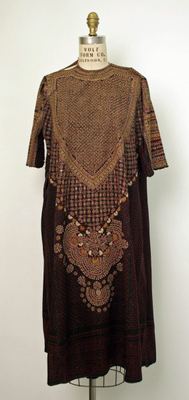
In the pictureA long tunic of dark brown silk is dressed on a mannequin. Grid-patterned embroidery covers the shoulders and chest, and below it a large embroidered panel of overlapping circles runs down to the waist. The sleeves are short, and there is an embroidered band at the hem as well. The embroidery threads are white, red and brown.
BackgroundThe kurta is a long tunic worn throughout South Asia, and the embroidery on the chest panel sets the garment's status. The grid and circle patterns here are seen in the embroidery of western India and the Sindh region of Pakistan, which sometimes also included small pieces of mirror. Using light thread on a dark ground is a way of making the embroidery stand out.
Puzzle tipThe embroidered pieces and the dark ground pieces are clearly distinct. Fit the circle-patterned pieces of the chest panel first, then set top and bottom with the grid pieces at the shoulders and the band at the hem. Fill in the dark brown pieces starting with those that touch the mannequin's outline. 100 pieces is a good fit.
- Classification
- Main dress-Womenswear
- Medium
- Silk; embroidered
- Dimensions
- Overall:
- Credit line
- Gift of Mrs. Yale Stevens, 1943
Source: The Metropolitan Museum of Art ↗
Stories about this work
- From Kurta to Cloak: Six Garments from the Islamic World, Told Apart by Shape
Even within Islamic-world dress, a different shape makes an entirely different garment. Six pieces, from two kurtas to a doll-sized wedding dress, sorted by form.