From Kurta to Cloak: Six Garments from the Islamic World, Told Apart by Shape
Published
Even with the same silk and the same gold thread, remove the sleeves and you have a waistcoat; add a hood and you have a cloak. The post on seven Indian men’s garments introduced one kurta alongside the angarkha and choga, but there were two more kurtas not yet covered. Starting with those two, I have gathered six garments of different shapes, through a waistcoat, a ceremonial coat and a cloak to a doll-sized wedding dress. Even within the same tradition of Islamic-world dress, change a single form and it becomes an entirely different garment.
| Work | Form | Materials |
|---|---|---|
| Kurta | Long tunic | Silk embroidery |
| Kurta | Long tunic | Silk embroidery |
| Waistcoat | Sleeveless top | Silk, metallic thread |
| Ceremonial Coat | Outer garment | Cotton, silk, metallic thread |
| Burnus / Selham | Hooded cloak | Silk |
| Palestinian Doll’s Thob al-Malek Royal Dress | Doll-sized dress | Cotton, silk |
Two kurtas that differ only in ground color
 Solve this painting as a puzzle → about 5 minutes on Easy
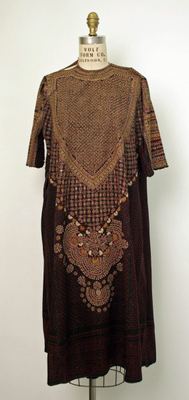
The first Kurta has grid and circular embroidery packed densely onto dark brown silk. Below the grid pattern covering the shoulders and chest, a large embroidered panel of overlapping circular motifs descends to the waist. Grid and circular patterns like these are seen in embroidery from western India and the Sindh region of Pakistan, and belong to the same family as the work covered in mirror embroidery. Originally, pieces of mirror were sometimes set in as well.
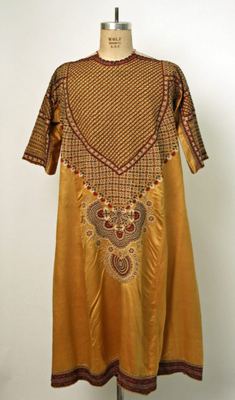
The second Kurta is almost identical in shape, but its ground is golden. An embroidered panel with a grid pattern covering the shoulders and chest descends in a V, with a red border. This site has several kurtas of the same type, so you can compare how the ground color and the arrangement of embroidery change. Golden silk was for feasts and weddings. The embroidered panels were made separately and sewn on, so when a garment wore out they were removed and reused.
The kurta is a long tunic worn by men and women alike throughout South Asia. These two are classified as women’s clothing in the collection records, so they differ from the one introduced earlier as menswear. It is best read as a single form used widely regardless of gender.
In both, the embroidered chest panel pieces and the ground pieces are clearly distinct, so in the puzzle, put together the embroidered panel first and fix top and bottom with the grid at the shoulders and the band at the hem.
A waistcoat with care given even to the lining
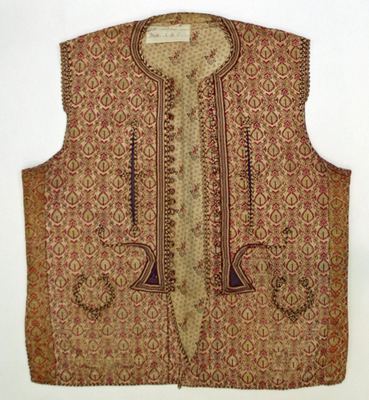
The Waistcoat is made of silk woven with small floral patterns, with gold thread edging and cord buttons. The outer fabric is a brocade mixing red and green, and the front opening, pocket openings and hem are edged in gold thread. Waistcoats of patterned silk were worn widely in the Ottoman Empire, India and Central Asia. They were worn under a long outer garment so the pattern showed between the front edges.
The lining shows one more round of effort. The inside is also lined with a small-patterned fabric, a sign of wanting the garment to look presentable even turned inside out. Cord buttons were an old way of fastening menswear in this region.
The small pattern repeats everywhere, so placing pieces in the puzzle is tricky. Build the frame first with the gold thread edging of the front opening and the curves of the pockets, and separate the lining from the outer fabric by brightness.
A court garment with a narrowly recorded date
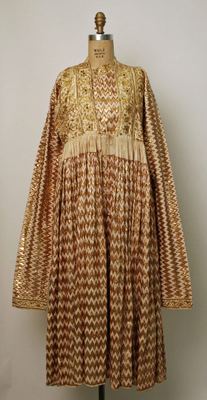
Unlike the other garments, the Ceremonial Coat has a narrowly recorded production date of 1884 to 1890. This is thanks to its clear history of acquisition. It is silk with a brown and off-white zigzag pattern, the shoulders and chest are covered with gold-thread embroidered panels, and below the waist a wide, finely pleated skirt spreads to below the knee. The gold embroidery at the shoulders and the fine pleats below the waist are elements of northern Indian court dress. The skirt was made to flare wide when the wearer walked or danced.
The gold embroidery at the shoulders and the zigzag pattern differ in texture, so start with the shoulders, and join the pattern by following its direction and the vertical lines of the pleats.
A cloak wrapped on without sleeves
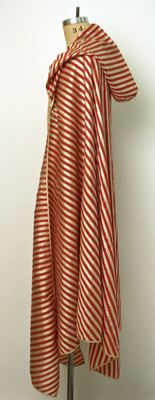
The Burnus / Selham is a hooded cloak made of red striped silk. Selham is the Moroccan name for the burnus. One made of silk instead of wool was worn by the urban wealthy on formal occasions. Striped silk was woven in the weaving workshops of cities such as Fez, and the color and width of the stripes could indicate a family or region. It is a separate work that only shares its name and form with the burnus covered in repeating patterns, so the two are worth comparing side by side.
In the puzzle, the angle of the stripes is the key. Near the shoulders they are close to vertical, and they become more diagonal toward the hem, so judge the height by the slope of the stripes in each piece.
A doll’s dress that miniaturizes a wedding dress
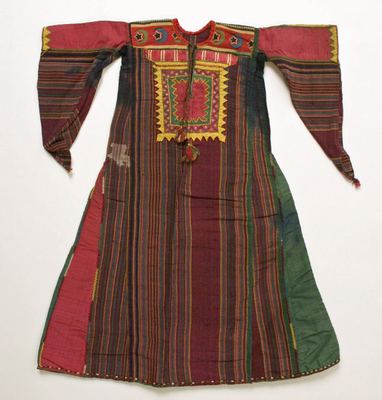
Last is the Palestinian Doll’s Thob al-Malek Royal Dress. “Thob al-malek” means “royal dress” and refers to the most lavish type of wedding dress in the Bethlehem region. An embroidered chest panel with a yellow border is attached to striped fabric in red, green and black. As a doll’s dress 53 centimeters long, it is much smaller than the real garment, but its construction is the same. The striped silk was woven in Syria, and the rule was to fill the chest panel embroidery with gold thread and silk. For people who could not try on a real wedding dress, it probably served as a sample showing its construction and colors at a glance.
Put together the yellow-bordered chest panel first, and continue the stripes while checking the order of colors against the preview. For all six garments, 48 to 100 pieces is about right.
Change the cut and the embroidery moves
Lay out the six garments in order of form, and they run from a long tunic to a waistcoat, an outer garment, a cloak and a miniature model. You can see at a glance how varied the silhouettes of Islamic-world menswear and garments worn by both men and women were. If six women’s dresses varied only the embroidery on the same form, here the forms themselves all differ.
A different cut means a different way of wearing, and a different way of wearing means different places for embroidery. The waistcoat lavished its care on the front opening, the coat on the shoulders and the doll’s dress on the chest panel. The people who made these clothes seem to have thought first about where on the body the garment would catch people’s eyes.