Kurta
A 19th-century Indian kurta of golden silk embroidered with a V-shaped chest panel of diagonal lattice and a large floral medallion. Full commentary ↓
Couldn't load the puzzle image.
Turn on piece outlines to see piece positions on this picture too
Drag the pieces into place · When zoomed in, drag an empty spot to move around
You can also play with a keyboard — Tab to the board, thenSpace pick a piece, Arrow keys move it (with Shift for small steps),Esc deselect, R rotate a piece (Shift+R the other way)
Kurta is a textile by an unknown maker (19th century) in the collection of The Metropolitan Museum of Art.
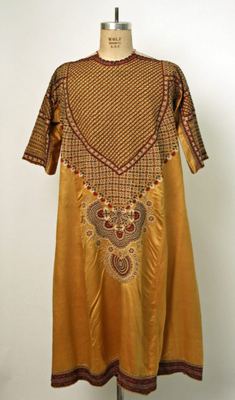
In the pictureA below-the-knee top of golden silk is shown on a mannequin. A panel covered in diagonal lattice embroidery descends in a V from the shoulders to the chest, outlined by a red line. Below the V, rows of small circle motifs continue and end in a red and white petal-shaped edge; above the belly is a large floral medallion in red, green and white thread, and below it another concentric-circle motif. The elbow-length sleeves also have lattice embroidery, and the hem is finished with a geometric band in red and indigo. A red border also runs around the neckline.
BackgroundThe Met's record describes it as a 19th-century kurta made in India, embroidered silk, 114.3cm high and 110.5cm wide. It is classified as women's clothing and was given by Mildred Barnes Bliss in 1943. This site also has a kurta of the same type, 86186, on a dark brown ground, so you can compare how different a similar embroidery layout looks depending on the ground color. Embroidery repeating lattices and circles like this is presented as belonging to the same family as embroidery from western India and Sindh, but the place of manufacture of this garment is recorded only as India.
Puzzle tipThe boundary between the golden ground and the embroidered areas is clear. Join the red border pieces of the V-shaped chest panel first to form a large triangle, then set up the central vertical axis with the petal edge and the large medallion below it. Fix left and right with the embroidered bands that bend from the shoulders onto the sleeves, frame the bottom with the hem band, and then place the broad golden pieces at the bottom by the sheen of the silk and its vertical folds. 100 pieces is about right.
- Classification
- Main dress-Womenswear
- Medium
- Silk; embroidered
- Dimensions
- Overall:
- Credit line
- Gift of Mildred Barnes Bliss, 1943
Source: The Metropolitan Museum of Art ↗
Stories about this work
- From Kurta to Cloak: Six Garments from the Islamic World, Told Apart by Shape
Even within Islamic-world dress, a different shape makes an entirely different garment. Six pieces, from two kurtas to a doll-sized wedding dress, sorted by form.