Maiden, Cupid and Frog
A winged Cupid aims his bow at a frog by a forest pool while a maiden watches from the bushes, a fairy-tale watercolor by an English architect. Full commentary ↓
Couldn't load the puzzle image.
Turn on piece outlines to see piece positions on this picture too
Drag the pieces into place · When zoomed in, drag an empty spot to move around
You can also play with a keyboard — Tab to the board, thenSpace pick a piece, Arrow keys move it (with Shift for small steps),Esc deselect, R rotate a piece (Shift+R the other way)
Maiden, Cupid and Frog is a watercolor by William Henry Romaine Walker (1890–1920) in the collection of The Metropolitan Museum of Art. It measures 25.1 cm × 18.7 cm.
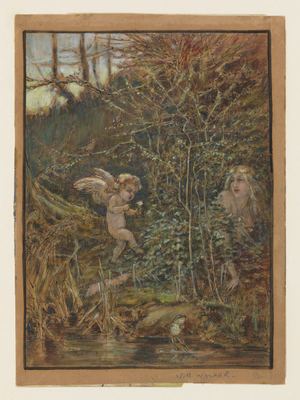
In the pictureIn the middle of a dark forest stands a winged infant Cupid holding a bow, and below him a frog sits in a pool. On the right, a woman with long blond hair peers out between the bushes, watching the scene. Every branch is drawn in close detail in brown and green ink and watercolor.
BackgroundWilliam Henry Romaine Walker was an architect who worked in London and painted fairy-tale pictures like this in his spare time. The work carries the taste of the late Victorian era, when stories of frog princes and fairies were in fashion, and what the picture is telling is left to the viewer's imagination. The fine branches were drawn in pen on a sheet 25 cm tall, then colored with watercolor.
Puzzle tipFine branches cover the whole picture, so the pieces look alike, but Cupid's white body and wings, the woman's blond hair and the bright pieces of the pool below fix their positions. Go around the edge first with the brown paper border pieces, then fill in the middle. 100 pieces or fewer are recommended.
- Artist
- British, Bury, Lancashire 1854–1940 Hastings, Sussex
- Classification
- Drawings
- Medium
- Ink and watercolor
- Dimensions
- 25.1 cm x 18.7 cm
- Credit line
- Purchase, Florence Waterbury Bequest, 1970
Source: The Metropolitan Museum of Art ↗
Stories about this work
- From Drawing-Room Conversation to Forest Fairy Tale: Four Scenes Caught on Paper
Not finished oil paintings but four sketches and watercolors on paper, from a drawing room in Revolutionary Paris to the leisure hours of a Victorian architect.