From Drawing-Room Conversation to Forest Fairy Tale: Four Scenes Caught on Paper
Published
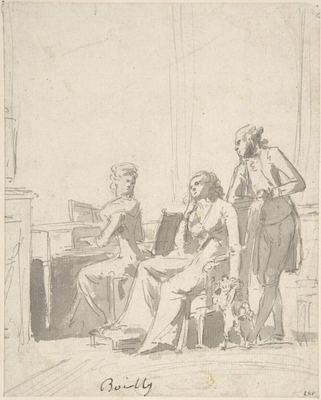
A woman seated at a piano, a woman resting her cheek on her hand, a man with folded arms, and a small dog at their feet. This interior, dashed off in gray wash, is not an oil painting but a sketch on paper. Museums keep more than large oil paintings. They also keep moments quickly set down on paper in ink or watercolor. The four works gathered here differ in artist and period, yet each one catches someone’s brief moment: a conversation in a drawing room, a fashion of the street, the stillness of a room, a scene from a forest fairy tale.
| Work | Artist | Date | Material |
|---|---|---|---|
| Conversation Piece | Louis Léopold Boilly | 1789–93 | Pen, gray wash |
| The Bouquet | Ernest-Ange Duez | unknown | Watercolor |
| A Woman Reading, after Pieter Janssens Elinga | François Bonvin | 1846–47 | Watercolor, gouache |
| Maiden, Cupid and Frog | William Henry Romaine Walker | unknown | Ink, watercolor |
A drawing room in Revolutionary Paris
 Solve this painting as a puzzle → about 5 minutes on Easy
The picture described at the start is Conversation Piece. On the left is the woman at the piano, beside her a woman resting her cheek on her hand, and on the right a man standing with folded arms.
A “conversation piece” is a format that shows a gathering of family or friends as a natural moment. It began in England and crossed over to France. Louis Léopold Boilly was a painter who liked to put the daily life of Parisians in the Revolutionary and Napoleonic eras onto small canvases. This drawing appears to be less a finished work than a study for working out a composition before painting in oil. It is the trace of testing on paper first who to seat where and which way to direct their gazes.
There is almost no color, so as a puzzle you end up starting with the outlines of the figures and the dark lines of the folds in their clothing. The trick is not to overlook small shapes like the dog at their feet.
Paris fashion of the 1880s: a navy dress and a pink bouquet
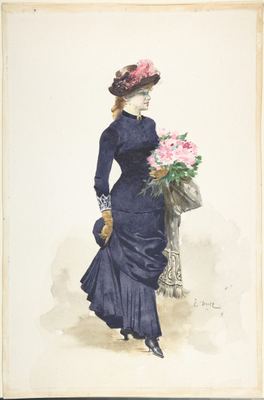
In The Bouquet, a woman in a navy dress stands on white paper holding a large pink bouquet. On her head is a small hat trimmed with flowers and ribbon, on her hands brown gloves, and her skirt is puffed out at the back. The background is nearly empty, so only the figure stands out clearly.
Ernest-Ange Duez made his name with watercolors and magazine illustrations depicting the portraits and fashions of women in Parisian society. The skirt puffed out at the back and the small flowered hat were fashions of the 1880s, so even though no date of execution survives, you can roughly guess the period. The pink bouquet stands against the navy dress and anchors the center of the picture.
It is a picture with many pieces of blank paper. Finish the dress and the bouquet first, then fill the remaining white space from the edges inward.
A 19th-century watercolor copied from a 17th-century interior
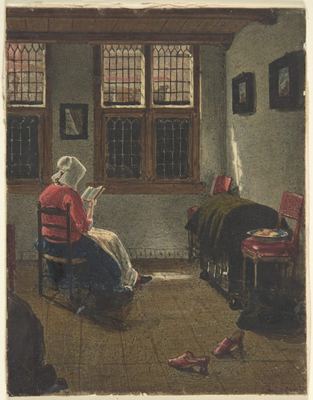
A Woman Reading, after Pieter Janssens Elinga already has “after” in its title. The original is an oil painting by the 17th-century Dutch painter Pieter Janssens Elinga, now in a museum in Munich, and the 19th-century Parisian painter François Bonvin made this watercolor copy after seeing it.
In a room where light comes through a leaded window, a woman in red with a white headscarf reads a book with her back turned. On the floor lies a pair of red slippers she has taken off. Bonvin admired Dutch interior painting and liked to paint quiet scenes of everyday life. The slippers and the woman’s back alone carry the stillness of Dutch interiors of Vermeer’s time intact across 200 years.
In the puzzle, there are only a few pieces with distinct color, like the window lattice, the red slippers and the red chair. Secure those first, and divide the dark parts of the room by differences in light and shade.
A fairy tale painted by a London architect in his spare time
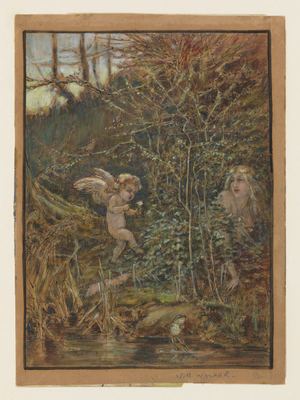
Maiden, Cupid and Frog shows, in the middle of a dark forest, a winged infant Cupid holding a bow and aiming at a frog in a pool. Through the bushes on the right, a woman with long blond hair peeks out and watches. Every branch is drawn densely in brown and green ink and watercolor.
It was painted by William Henry Romaine Walker. Painting was not his profession; he was an architect working in London. He painted fairy-tale pictures like this in his leisure time. The taste of the late Victorian era, when stories of frog princes and fairies were in fashion, shows through plainly, yet no explanation survives of what story the picture is meant to tell. Why Cupid is aiming at the frog and why the maiden watches from hiding is left to the viewer to interpret.
Of the four, it is the trickiest as a puzzle. The twigs are dense, so it is best to begin by picking out bright pieces like Cupid’s wings and arrow and the woman’s blond hair. None of the four pictures is large, so 24 or 48 pieces suits them.
Pictures that never became oil paintings, or never needed to
Put the four together, and you can see what paper as a medium is well suited for. Thoughts before moving to oil (Boilly), a record of passing fashion (Duez), admiration for the painting of another age (Bonvin), a personal pleasure unrelated to one’s profession (Walker). If the finished oil painting is the result, these pictures are the process leading to that result, or records of moments that never sought a result in the first place.
The same was true of Degas and Lautrec’s drawings and the Barbizon painters’ sketches. In a museum we tend to stop in front of the large oil paintings, but the movements of a hand left on paper hold a sincerity of a different grain from oil.