Pygmalion and Galatea
As a sculptor kisses the marble woman he made, her body turns to flesh from the top down: Gérôme's best-known work, staging the myth in a studio. Full commentary ↓
Couldn't load the puzzle image.
Turn on piece outlines to see piece positions on this picture too
Drag the pieces into place · When zoomed in, drag an empty spot to move around
You can also play with a keyboard — Tab to the board, thenSpace pick a piece, Arrow keys move it (with Shift for small steps),Esc deselect, R rotate a piece (Shift+R the other way)
Pygmalion and Galatea is an oil painting by Jean-Léon Gérôme (ca. 1890) in the collection of The Metropolitan Museum of Art. It measures 88.9 × 68.6 cm.
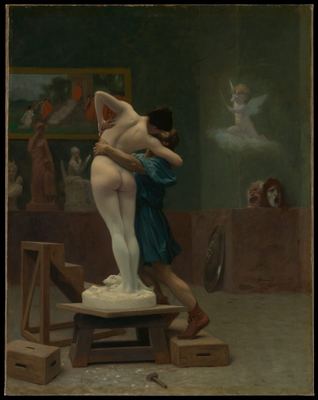
In the pictureIn a studio, a white marble statue of a woman on a pedestal turns to kiss the sculptor. Her legs are still marble, while from the waist up she is turning flesh-colored. The sculptor rises on his toes and embraces her. Above, Cupid flies with an arrow; masks and a shield hang on the wall, and small statues stand on a table.
BackgroundPainted around 1890, it tells a story from Ovid's Metamorphoses. When Pygmalion, a sculptor of Cyprus, fell in love with the ivory woman he had made, Aphrodite turned the statue into a living person. Gérôme took up sculpture himself late in life, and the statue in this painting is a marble he actually made. The studio in the picture is his own. He also painted a separate version of the same scene seen from behind.
Puzzle tipThe white bodies of the two figures and the dark background separate clearly. Complete the figures first, and use the objects on the wall (masks, shield, statues) as reference points for the background. In the legs, where marble turns to flesh, the shades of white are very subtle, so zoom in. Cupid's wings are a good clue near the top.
- Artist
- French, Vesoul 1824–1904 Paris
- Classification
- Paintings
- Medium
- Oil on canvas
- Dimensions
- 88.9 x 68.6 cm
- Credit line
- Gift of Louis C. Raegner, 1927
Source: The Metropolitan Museum of Art ↗