Saint Philip
The young apostle Philip in a red robe and pale pink mantle, holding a green book. A panel by Spinello Aretino, 1384–85, with its name band intact. Full commentary ↓
Couldn't load the puzzle image.
Turn on piece outlines to see piece positions on this picture too
Drag the pieces into place · When zoomed in, drag an empty spot to move around
You can also play with a keyboard — Tab to the board, thenSpace pick a piece, Arrow keys move it (with Shift for small steps),Esc deselect, R rotate a piece (Shift+R the other way)
Saint Philip is a tempera and gold painting by Spinello Aretino (1384–85) in the collection of The Metropolitan Museum of Art. It measures 2.9 cm.
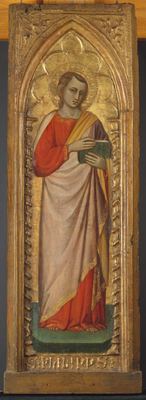
In the pictureIn a narrow panel whose pointed gold-ground arch is cut on the inside into a petal-shaped curve, a young beardless man stands. Over a red robe he wears a pale pink mantle with a gold lining, and he holds a green-covered book to his chest with both hands, his head slightly bowed. His halo is patterned with punched dots, and the columns on either side are carved in relief like twisted rope. He stands barefoot on a green step, and at the very bottom the name "S. PHILIPPUS" is written in gold. The edge of the mantle is trimmed in gold and falls to the tops of his feet.
BackgroundSpinello Aretino was a Tuscan painter born in Arezzo who died there in 1410, and he left many large altarpieces and murals. This panel dates from 1384–85, and because it matches "A Saint, Probably James the Greater," painted by the same artist at the same time, in size (about 52×18cm with frame), arch, and twisted-column decoration, the two are thought to be companion panels from one altarpiece. Philip is often shown with a young face and a book, and here the surviving name band at the bottom makes his identity clear. The painted surface without the name band is 46×13.7cm. It entered the museum in 1975 with the Robert Lehman Collection.
Puzzle tipThe red robe, pale pink mantle, and gold leaf divide into large blocks. Assemble the face and the green book first, then work downward along the gold border of the mantle. The twisted columns on either side run in long vertical lines and are good for standing up the frame, and the lettering of the name and the green step at the bottom finish the base. Closing the top with the curve of the arch narrows down the gold pieces. The shadows of the twisted columns' relief are consistent, which keeps you from mixing up left and right. 24 or 48 pieces is a good fit.
- Artist
- Italian, born Arezzo 1345–52, died 1410 Arezzo
- Classification
- Paintings
- Medium
- Tempera on wood, gold ground
- Dimensions
- 2.9 cm
- Credit line
- Robert Lehman Collection, 1975
Source: The Metropolitan Museum of Art ↗
Stories about this work
- Altarpieces Sold Off Panel by Panel: Three Pairs in the Robert Lehman Collection
Large Italian altarpieces were often taken apart and sold panel by panel on the art market. We read the traces of that through three pairs of panels that survive together on this site.
Puzzles to try next

More Robert Lehman Collection puzzles· Stories and puzzle tips