Altarpieces Sold Off Panel by Panel: Three Pairs in the Robert Lehman Collection
Published
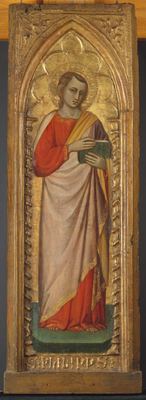
Inside a gilded arch, a young apostle holds up a book with both hands. In the panel beside it, a bearded saint leans on a staff. The two pictures were originally together in a single altarpiece. The Robert Lehman Collection has a number of small panel paintings like these, and some of them were not small pictures to begin with but fragments that came away from much larger altarpieces. Large altarpieces were divided into panels, saint by saint, and from the modern era onward it was common on the art market for such altarpieces, unable to sell whole, to be taken apart and sold panel by panel. Three pairs of panels that were scattered this way have come together again as pairs.
| Pair | Artist | Date | Material |
|---|---|---|---|
| Saint Philip · A Saint, Possibly James the Greater | Spinello Aretino | 1384–85 | Tempera on wood, gold ground |
| The Flagellation · The Entombment | Master of Forlì (name unknown) | first half of the 14th century | Tempera on wood, gold ground |
| Male Saint · Saint Bernard of Clairvaux | Workshop of Fra Filippo Lippi | ca. 1447–69 | Tempera and gold on wood |
A young apostle and an old apostle
 Solve this painting as a puzzle → about 5 minutes on Easy
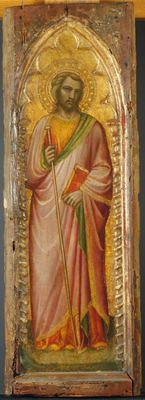
Saint Philip and A Saint, Possibly James the Greater come from an altarpiece Spinello Aretino painted in 1384–85. That is also why the two panels are together in the same museum.
Set side by side, they show what the artist was aiming for. Philip is a young face holding up a book inside a gilded arch, and the other is a bearded face holding a staff and a book. The composition pits a young apostle against an old one. Because the staff is a pilgrim’s emblem, this saint is thought to be James the Greater, but that has not been confirmed.
From the Flagellation to the Entombment: the beginning and end of the Passion
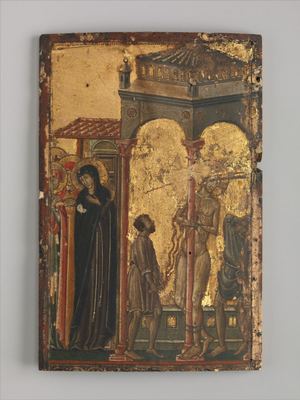
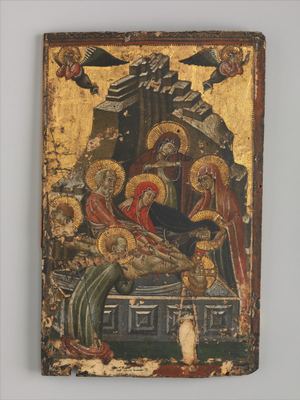
The painter of The Flagellation and The Entombment is known only by the nickname “Master of Forlì.” The name was given because almost nothing is known about him beyond the fact that he worked in Romagna, in northern Italy.
The two panels are very small pictures, around 20 centimeters tall. They were originally part of a small altarpiece that divided the scenes of the Passion into several compartments. The story begins in The Flagellation, with Christ being whipped, and ends in The Entombment, as he is laid in a stone sarcophagus. How many more panels there may have been in between cannot be known from the material available now. Still, these two scenes, the beginning and the end, have survived side by side.
The mix of styles in The Entombment is also worth seeing. The way rocky mountains are stacked in tiers to build space comes from Byzantine icons, while the haloes and the colors of the figures’ clothing come from Western European Gothic. It is the hybrid character typical of painting in Romagna, with Eastern and Western traditions meeting on a palm-sized panel.
Panels 13cm wide that filled the pillars beside an altarpiece
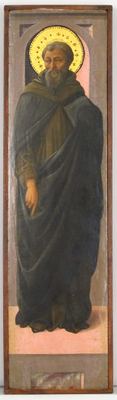
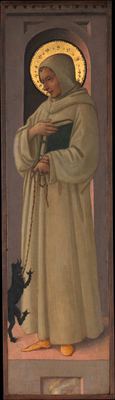
Male Saint and Saint Bernard of Clairvaux had a different purpose from the start. They were panels set into the pillar positions (pilasters) on either side of a large altarpiece, and they are only 13cm wide. They were not pictures presenting a saint at the center, but narrow pillars decorating its sides.
The two panels are identical in size, 12.7 centimeters wide and 48.3 centimeters tall. They are said to have been made in the workshop of Fra Filippo Lippi. The Male Saint, in a black habit, is a Benedictine monk whose identity has not been established. Saint Bernard of Clairvaux, in a white habit, has a small demon bound in chains at his feet, so his identity is clear. It is an iconography signifying that he overcame temptation and heresy. A saint whose name survives and a saint whose name does not stood guard on the left and right of one altarpiece.
Why were they scattered like this?
Several reasons are known for why large altarpieces were broken up and sold. Churches disposed of old altarpieces when they closed or were rebuilt. On the 19th- and 20th-century art market, small panels were much easier for private collectors to hang on their walls. Few people could afford to buy a large altarpiece whole, but a palm-sized panel with a single saint was a different matter.
So pictures that were once one body scattered to museums and private collections around the world. That these three pairs remain together in the Lehman Collection means that, even as things were dispersing, they were sold together or met again somewhere along the way.
The order for assembling narrow figures on gold grounds
All six show a figure standing on a gold ground in a tall, narrow composition, so the approach is similar. Assemble the two pieces from the same altarpiece one after the other, and you feel at your fingertips the composition the artist planned, whether a contrast, a beginning and end, or a left-right symmetry. That is the pleasure of assembling paired panels. The boundary between the gold background and the figure is distinct, so build the framework from pieces with the outlines of clothing and faces, and fill the gold from around the halo outward, as in the gold-ground panel painting puzzle guide. Symbols like the book, the staff and the chained demon have clear shapes and make good reference points.
I recommend 24 to 48 pieces. Very narrow pictures like the pilaster panels are cut into tall, thin pieces, so a lower piece count is easier.
Panels that wandered for centuries and became neighbors again
Each of the six is a fine picture on its own, but they look different once you know their pairs. Youth and age, beginning and end, the named and the nameless. Panels that once stood side by side before the same altar wandered for centuries and became neighbors again in this museum. Compare them with the portraits of Saint Bernardino, in which Sienese painters depicted the same saint again and again, and you can also feel how pictures paired within one altarpiece differ from pictures that separately repeat the same subject. Few examples show the art-market history of altarpieces being taken apart and gathered again as quietly as this.