Statuette of Merer
A wooden statuette of Merer with bold black writing on a yellow belt and white kilt: a 33cm figure with a darkened body and a gray-green front panel. Full commentary ↓
Couldn't load the puzzle image.
Turn on piece outlines to see piece positions on this picture too
Drag the pieces into place · When zoomed in, drag an empty spot to move around
You can also play with a keyboard — Tab to the board, thenSpace pick a piece, Arrow keys move it (with Shift for small steps),Esc deselect, R rotate a piece (Shift+R the other way)
Statuette of Merer is a wooden object by an unknown maker (ca. 1981–1802 B.C.) in the collection of The Metropolitan Museum of Art. It measures H. 33 cm (13 in.).
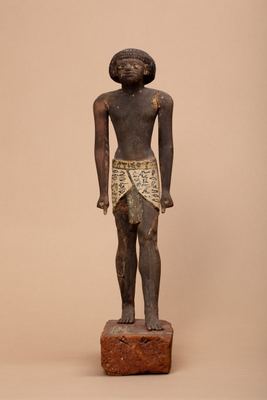
In the pictureAgainst an apricot background, a man of darkened brown wood stands on a cracked red base. Below his round head, carved with a curly texture, white paint remains in the eyes, and at the shoulders the joins where the separately carved arms were fitted can be seen. Bold black hieroglyphs are written on the white kilt, the black writing continues on the yellow belt above, and a gray-green front panel hangs down the middle. Yellow paint remains at the tips of both clenched fists. The paint on the body has worn away less than on the Merer statue with red writing. There is also a small text panel at the front of the top of the base.
BackgroundIt is one of four statues made for the same Merer, 33cm high, with the recorded materials wood, paint and gesso. It is nearly the same in size and dress as the 33.5cm statue whose kilt is filled with red writing, but this one has black writing and a redder, more roughly cracked base. Even when made from the same model, the faces, proportions and finish differ slightly, the variation of handmade objects. The recorded date is the 10th to 11th Dynasty, and the findspot is thought to be Asyut. The joins at the shoulders show the Egyptian method of making wooden statues by carving the body and arms separately and attaching them.
Puzzle tipThe black writing is bold and large, which helps place the kilt pieces. Gather the yellow belt, the gray-green front panel and the white kilt first, then fix the top and bottom with the head and face and the red base below. The dark arms and legs contrast clearly with the background, so join them vertically along their outlines, and fill the apricot background last. The cracks in the base are shaped differently on each piece, which helps settle positions at the bottom. 24 or 48 pieces is about right.
- Period
- Middle Kingdom
- Dynasty
- Dynasty 10–11
- Medium
- Wood, paint Gesso
- Dimensions
- H. 33 cm (13 in.)
- Credit line
- Rogers Fund, 1910
Source: The Metropolitan Museum of Art ↗
Stories about this work
- Four Wooden Statuettes of the Same Man, Merer, Side by Side
Four wooden tomb statuettes from Egypt's Middle Kingdom. They depict the same person, yet the pose, the paint, and even the color of the writing on the kilt differ slightly.