Four Wooden Statuettes of the Same Man, Merer, Side by Side
Published · updated
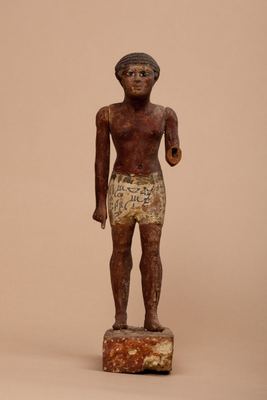
Short hair, a white kilt, a brown body. The Egyptian Art section has four small wooden figures that look like this, and all four carry the same name tag. They are painted wooden statuettes of a man named Merer. They came in together in 1910 through the Rogers Fund and date to the Middle Kingdom (roughly 1981–1802 B.C.). They appear to come from the same tomb, but the dynasty given in the museum’s records is split: three are listed as Dynasty 10–11 and one as Dynasty 12.
| Work | Dynasty | Height | Material |
|---|---|---|---|
| Statuette of Merer | Dynasty 12 | 23.5 cm | Wood, paint, gesso |
| Statuette of Merer | Dynasty 10–11 | 33.5 cm | Wood, paint |
| Statuette of Merer | Dynasty 10–11 | 35.6 cm | Wood, paint, gesso |
| Statuette of Merer | Dynasty 10–11 | 33 cm | Wood, paint, gesso |
 Solve this painting as a puzzle → about 5 minutes on Easy
Four that split into two pairs
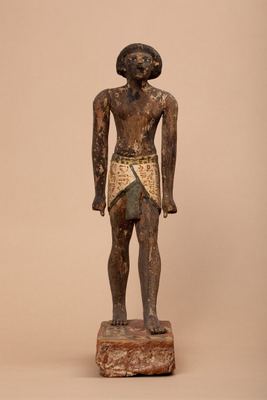
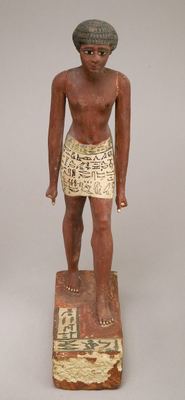
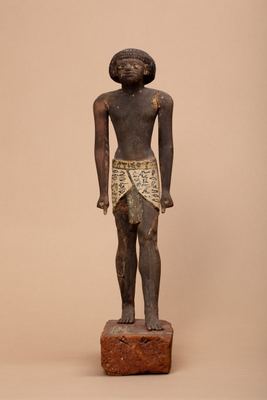
Their heights vary from 23 to 36 centimeters. The basic attire is the same, but look for a while and they sort themselves into pairs. Nos. 544202 and 544204 have bodies with well-preserved reddish-brown paint and step forward with the left foot. In Nos. 544203 and 544205, the paint has darkened and flaked off in places, a grayish-green front panel hangs down the middle of the white kilt, and they stand with their feet almost together. Placing several individual statues like these in a tomb was not unusual.
Why make one person four times? There are two explanations. One is that they were meant to be distributed to different places in the tomb; the other is that if one was damaged, another could still serve as a home for the spirit. For the ancient Egyptians, a statue was a vessel where the spirit (ka) of the dead resided. With only one vessel, the spirit would have nowhere to go if it broke. Making four was probably a safeguard against that.
If these explanations are right, the four were made from the start to be used as a set. The museum did not just happen to gather four statues of the same man.
Writing brushed onto the kilt
All four have writing on the white kilt. It is mostly black, but on No. 544203 alone it is written in red, and No. 544204 has some green mixed in. It appears to be Merer’s name and an offering prayer. Prayers like this commonly include a set formula asking for offerings such as bread and beer.
The densest text is on No. 544204. Writing fills not only the whole kilt but also the top and front of the base, making it look like a small stela set up on its own. It is also worth noticing that the writing was done with a brush. That suggests a scribe may have added the text separately after a sculptor carved the form, and if so, at least two people’s hands touched even this small statue.
They depict the same person, yet the face, proportions, pose, and paint all differ slightly. These are the differences that naturally arise in anything made by hand. It is like ordering four of the same item and finding that each one is subtly different when they arrive. Even if there was a model, the final touches were made by a person.
Silhouette before background
All four show a brown figure standing against an almost single-color gray or apricot background. It is a composition where the strategy for pictures with large single-color areas works just as it is. The body’s outline separates sharply from the background, so going around the edges first quickly gives you the frame. The writing on the kilt has strokes in different positions on each piece, which makes for good reference points, and No. 544204, precisely because its text is so dense, is actually easier to place. The red stone of the base is simple, so fill it in after you finish the figure. Background pieces are almost impossible to tell apart, so it is easiest to think of it as finishing the outline first and then filling the remaining holes.
Easy (about 24 pieces) or Normal (about 48) is the right size. The four are similar in size, so solving them side by side at the same difficulty lets you feel the difference between the two pairs in your hands.
The maker has no name
The name Merer has survived for nearly 3,800 years thanks to the writing on the kilt. The name of the person who carved him appears nowhere. As discussed in What “unknown artist” means, the clearer an object’s purpose, as with tomb goods, the more likely it is that the name of its recipient survives rather than that of its maker. The other conventions Egyptian sculpture followed are in Conventions of Egyptian statues, and tips for solving the whole section are in the Egyptian art puzzle guide.
Solve the four in turn and the same face comes to you a little differently each time. An unknown hand repeated the same task four times for one person, and the small discrepancies between those repetitions are the most human traces that remain.