The Death of Socrates
Reaching for the cup of poison, the philosopher raises his other hand to the sky and keeps talking; his disciples weep, and Plato sits at the foot of the bed. Full commentary ↓
Couldn't load the puzzle image.
Turn on piece outlines to see piece positions on this picture too
Drag the pieces into place · When zoomed in, drag an empty spot to move around
You can also play with a keyboard — Tab to the board, thenSpace pick a piece, Arrow keys move it (with Shift for small steps),Esc deselect, R rotate a piece (Shift+R the other way)
The Death of Socrates is an oil painting by Jacques Louis David (1787) in the collection of The Metropolitan Museum of Art. It measures 129.5 × 196.2 cm.
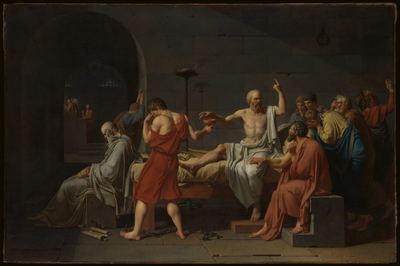
In the pictureOn a bed in front of the stone walls of a prison, an old man in white sits pointing to the sky with one hand while reaching for the cup of poison with the other. The man handing him the cup cannot bear to look and covers his face. The disciples around him weep or collapse against the wall. At the foot of the bed an old man sits quietly with his back turned. Through the door on the left, the family can be seen leaving.
BackgroundIt was shown at the Paris Salon in 1787, two years before the French Revolution. It depicts Socrates, sentenced to death for impiety and for corrupting the young, drinking the hemlock, a scene recorded in Plato's Phaedo. The old man at the end of the bed is Plato, though in reality he was young at the time and was not present. David chose the message of a man dying for truth over historical fact. It is a textbook example of Neoclassicism.
Puzzle tipThe twelve figures each wear a different color, which provides many clues. Fix Socrates in white at the center and the man in red holding the cup first, then widen out to the left and right. Leave the gray stone wall pieces for last. The joints between the stones of the wall show the vertical position. This picture suits 300 pieces well.
- Artist
- French, Paris 1748–1825 Brussels
- Classification
- Paintings
- Medium
- Oil on canvas
- Dimensions
- 129.5 x 196.2 cm
- Credit line
- Catharine Lorillard Wolfe Collection, Wolfe Fund, 1931
Source: The Metropolitan Museum of Art ↗