Card Players in a Drawing Room
Guests absorbed in cards in a candlelit drawing room, with a servant at the fireplace and a dog on the floor: an evening in 18th-century Parisian high society. Full commentary ↓
Couldn't load the puzzle image.
Turn on piece outlines to see piece positions on this picture too
Drag the pieces into place · When zoomed in, drag an empty spot to move around
You can also play with a keyboard — Tab to the board, thenSpace pick a piece, Arrow keys move it (with Shift for small steps),Esc deselect, R rotate a piece (Shift+R the other way)
Card Players in a Drawing Room is an oil painting by Pierre Louis Dumesnil the Younger (ca. 1756–59) in the collection of The Metropolitan Museum of Art. It measures 79.1 × 98.4 cm.
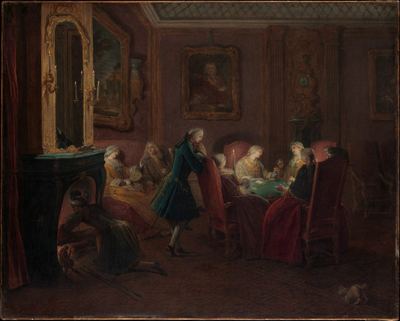
In the pictureIn a drawing room hung with red wallpaper and paintings, six men and women sit around a candlelit table playing cards. On the left is a fireplace with a gilded mirror and a servant crouching in front of it, and on the right a small dog sits on the floor. A standing man looks over the game, and everything down to the ceiling beams and the frames on the walls is painted in detail.
BackgroundPierre Louis Dumesnil painted interior genre scenes in 18th-century Paris, and this picture shows an evening gathering of aristocrats or wealthy citizens. Card playing was the most common social pastime of the upper classes at the time, and faces glowing red under candlelight were a favorite subject of the period's painting. It is a pleasure that even the portraits and landscapes hanging on the walls are painted clearly enough to make out one by one.
Puzzle tipInterior scenes have many straight lines, which works in your favor. Build the top frame first from the ceiling beams and the edges of the picture frames on the wall, then add the bright pieces around the gilded mirror on the left and the candles. Fill the red wallpaper starting with the pieces that touch a frame, and you will be left with fewer stray pieces.
- Artist
- French, Paris 1698–1781 Paris
- Classification
- Paintings
- Medium
- Oil on canvas
- Dimensions
- 79.1 x 98.4 cm
- Credit line
- Bequest of Harry G. Sperling, 1971
Source: The Metropolitan Museum of Art ↗
Stories about this work
- What to Know Before Your First 300-Piece Puzzle
A 300-piece puzzle takes more than three times as long as a 100-piece one. What changes on screen, how to finish one section at a time, and which pictures suit a first 300.
- Why Dogs and Horses Turn Up So Often in Old Master Paintings
Animals in old paintings were both decoration and symbol: the dog for loyalty, the horse for status and authority, the bird for freedom and the soul. Small supporting players you find while doing the puzzle.