The Three Ages of Humans
Three generations in a forest landscape: children spy on lovers while old men sit in the shade, in an allegory by the Ferrara court painter Dosso Dossi. Full commentary ↓
Couldn't load the puzzle image.
Turn on piece outlines to see piece positions on this picture too
Drag the pieces into place · When zoomed in, drag an empty spot to move around
You can also play with a keyboard — Tab to the board, thenSpace pick a piece, Arrow keys move it (with Shift for small steps),Esc deselect, R rotate a piece (Shift+R the other way)
The Three Ages of Humans is an oil painting by Dosso Dossi (ca. 1515) in the collection of The Metropolitan Museum of Art. It measures 77.5 × 111.8 cm.
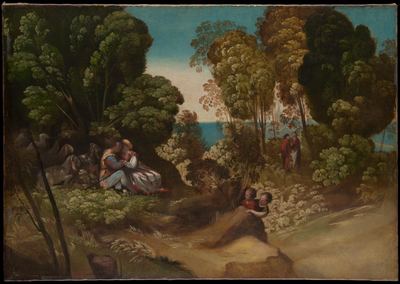
In the pictureThe sea and sky show through a dense forest. Old men sit in the shade at the left, and in the middle two children hide behind a bush, peeking at something. At the end of their gaze, toward the upper left, a young man and woman sit side by side, and at the back right a flock of sheep and a shepherd appear small. Greens and blues fill the picture.
BackgroundBecause children, lovers and old people share one landscape, it is called "the three ages of life," but its exact meaning has not been established. Dosso Dossi was court painter to the Duke of Ferrara, and he favored the color of Venetian painting, poetic landscapes and enigmatic allegories. A forest that dominates the picture more than the figures do is unusual for an Italian painting of that time.
Puzzle tipIt is difficult because most of the pieces are green. Fit the blue pieces of sky and sea first, fix the skin and clothing pieces of the figures in their places, and then fill in the green by sorting it into bright leaves and dark shade. 100 pieces is recommended.
- Artist
- Italian, Tramuschio ca. 1486–1541/42 Ferrara
- Classification
- Paintings
- Medium
- Oil on canvas
- Dimensions
- 77.5 x 111.8 cm
- Credit line
- Maria DeWitt Jesup Fund, 1926
Source: The Metropolitan Museum of Art ↗
Stories about this work
- From Young Painter to Old Man: A Life in the Last Four European Paintings
A painter painted by a painter, a nameless old man, an inscrutable allegory and a palm-reading swindle. Four seemingly unrelated works, gathered under the frame of scenes from a life.