From Young Painter to Old Man: A Life in the Last Four European Paintings
Published
A young painter in front of a red chair, a white-haired old man sunk into an armchair, children spying on lovers in a forest, and a fortune-teller pretending to read a palm. These are the last four works remaining in the European Paintings section. The painters and periods do not overlap, yet placed side by side they connect in a curious way. They are things that happen between being born and growing old.
| Work | Painter | Date |
|---|---|---|
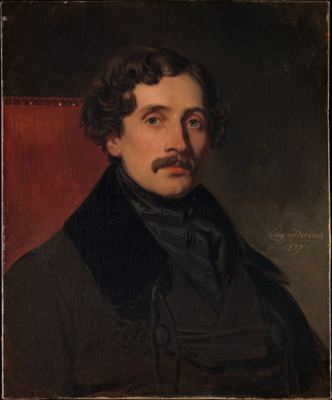
| Louis-Félix Amiel (1802–1864) | Eugène Devéria | 1837 |
| Portrait of an Old Man | Francisco Domingo y Marqués | 1882 |
| The Three Ages of Humans | Dosso Dossi | ca. 1515 |
| A Couple in an Interior with a Fortune-Teller | Jacob Duck | ca. 1632–33 |
A painter painted by a painter
 Solve this painting as a puzzle → about 5 minutes on Easy
In the portrait of Louis-Félix Amiel, a young man with black hair and a mustache faces forward with his back to a red chair. He wears a black scarf around his neck, and soft light falls on his face.
Amiel was a painter active in Paris. Eugène Devéria, who painted him, was a Romantic painter of the same generation; after making his name with a large work at the Salon of 1827, he left many portraits. His older brother Achille Devéria was also a painter. Perhaps because it is a picture of a colleague, the clothing is plain and the gaze is calm. There is an ease that seems possible only between people who know each other’s work well.
The face, the white shirt collar and the red chair are clearly separated by color, so as a puzzle, start with the face and set the chair on the left, and the remaining positions narrow down quickly.
An old man whose name did not survive
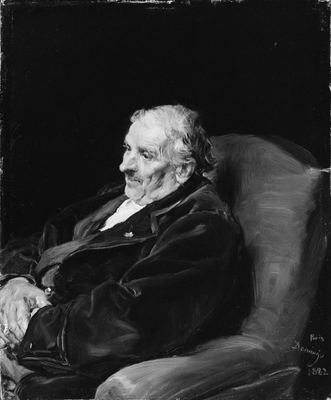
In Portrait of an Old Man, a white-haired old man sits in a dark room, almost buried in a large armchair. A white shirt peeks out between his black clothes, his hands are folded on his knees, and his face turns to the left. The brushwork is rough and quick, on a small wooden panel 27 centimeters tall.
Francisco Domingo y Marqués came from Valencia and became popular in Paris for quickly painting figures and interiors on small panels. Who this old man was is not recorded. That anonymity actually makes the painting more comfortable. It lacks the formality a commissioned portrait would have had, and keeps the familiarity of a study that captured someone near the painter in passing.
The black clothes and dark background look alike, but the sheen of the brushwork differs. Complete the face first and expand slowly toward the background.
An allegory no one can decode
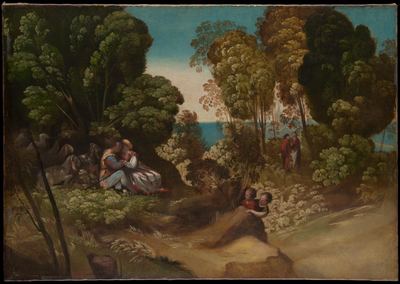
The Three Ages of Humans has an entirely different texture. Sea and sky show through a dense forest, and old people sit in the shade on the left. Behind a thicket in the middle, two children hide and peer at something, and at the end of their gaze a young man and woman sit side by side. At the back on the right, a flock of sheep and a shepherd appear small.
Because children, lovers and old people are gathered in a single landscape, it was given the title “The Three Ages of Humans,” but its exact meaning has not yet been worked out. Dosso Dossi was court painter to the Duke of Ferrara and liked to paint Venetian-style color, poetic landscapes and enigmatic allegories. A composition in which the forest fills more of the picture than the figures was rare in Italian painting of the time. The children are secretly watching lovers, and old people are beside them. That is about all the clues there are, so it is hard to piece the story together completely.
It is no easy puzzle, either. Green and blue cover most of the picture, so you have to find the pieces with people in them first, like the children in the thicket and the old people on the left, and set them in place. The trees and sky come last.
A pickpocket behind the palm reading
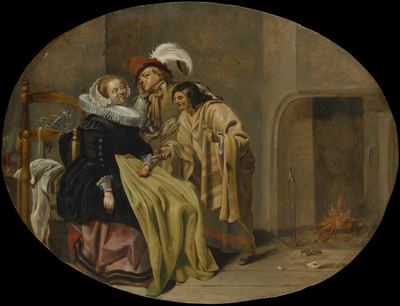
A Couple in an Interior with a Fortune-Teller shows, within an oval picture, a room with a fire burning in the fireplace. A woman in a white ruff, black clothes and a green skirt sits holding out her hand, and an older woman wrapped in a patterned shawl peers into it. Behind them stands a man in a feathered hat.
A Gypsy fortune-teller pretending to read a palm while stealing a purse was a frequent subject in 17th-century Dutch genre painting. Trace it back and you reach Caravaggio’s The Fortune Teller. Jacob Duck worked in Utrecht and liked to paint interior scenes with soldiers and women. The oval format was a particular favorite of collectors at the time, and in the puzzle, if you set this oval frame first, the arrangement of the figures inside sorts itself out.
For piece counts, 48 pieces suits the two portraits, and 100 pieces suits the allegory and the genre scene, whose figures and backgrounds are more complex.
Four paintings like one person’s life
You can see a progression without forcing a story. A painter calmly records a fellow painter, and a nameless old man sits quietly at the far end of life. Children, lovers and old people watch one another within one landscape. And somewhere in between, someone uses palm reading as an excuse to go after another person’s purse. Portrait, allegory and genre painting: the genres are all different, but in the end they are different facets of how people live.
With these four works, the European paintings come to a close for now. If you have already met the two self-portraits by Drost and Ducreux or Dietrich, who imitated other painters’ styles, these four fall well short in name recognition. Still, as paintings that hold onto one person’s life, or the stages of life as a whole, they lack nothing.