Andiron
A 14th-century Italian iron stand that held logs in a fireplace; the hooks at the top and the curved legs show the blacksmith's skill. Full commentary ↓
Couldn't load the puzzle image.
Turn on piece outlines to see piece positions on this picture too
Drag the pieces into place · When zoomed in, drag an empty spot to move around
You can also play with a keyboard — Tab to the board, thenSpace pick a piece, Arrow keys move it (with Shift for small steps),Esc deselect, R rotate a piece (Shift+R the other way)
Andiron is a metal object by an unknown maker (14th century) in the collection of The Metropolitan Museum of Art. It measures 80.3 × 22.5 × 58 cm.
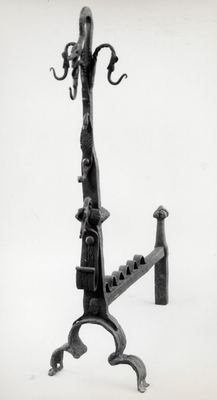
In the pictureA black iron stand stands against a white background. Several hooks are attached near the top of a tall upright, there is a small box-shaped ornament midway up, and at the bottom it stands on legs that curve out in two directions. A crossbar for holding logs extends to the side. The museum's image is black and white.
BackgroundAndirons were set in a fireplace in pairs facing each other to raise the logs off the floor, letting air through so the fire burns well. The hooks at the top were for hanging pots or spits, and 14th-century Italian blacksmiths added scrolls and animal-head ornaments even to practical objects like this. It is a rare object showing the kitchen and heating of a medieval household.
Puzzle tipWith only the thin form of the black iron and a white background, it is solved by shape. Fit the curved pieces of the hooks at the top and the legs at the bottom first, then join the straight pieces of the upright. Fill in the white background pieces starting with those the iron runs across. 24 pieces is recommended.
- Culture
- Italian
- Classification
- Metalwork-Iron
- Medium
- Iron
- Dimensions
- 80.3 x 22.5 x 58 cm
- Credit line
- Rogers Fund, 1908
Source: The Metropolitan Museum of Art ↗
Stories about this work
- From Andirons to Wall Tiles: Five Medieval Objects Without a Single Saint
No saints, no kings. Iron that held up firewood, tiles that covered walls, a marble roundel that decorated a building. Everyday objects and architectural ornament from the Middle Ages that are not religious art.