From Andirons to Wall Tiles: Five Medieval Objects Without a Single Saint
Published · updated
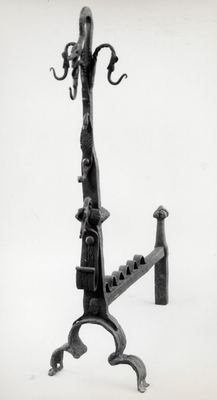
A piece of iron that once held up firewood inside a fireplace is fitted with scrolls and animal heads. Most of the Medieval Art department consists of paintings and carvings of saints, the Virgin and sacred objects, but the five pieces chosen here have no saints and no kings. Iron fittings from beside the hearth, tiles that covered walls, and a marble roundel once set into the wall of a building. These are practical objects that decorated the kitchens and building walls of medieval people.
| Work | Culture | Period | Material |
|---|---|---|---|
| Andiron | Italy | 14th century | Iron |
| Wall Bracket | Italy | 14th century | Iron |
| Wall Tile (large) | Spain | 15th century | Glazed earthenware |
| Wall Tile (small) | Spain | 15th century | Glazed earthenware |
| Decorative Roundel | Italy (Venice) | 12th–13th century | Marble |
A pair of iron pieces by the fireplace
 Solve this painting as a puzzle → about 5 minutes on Easy
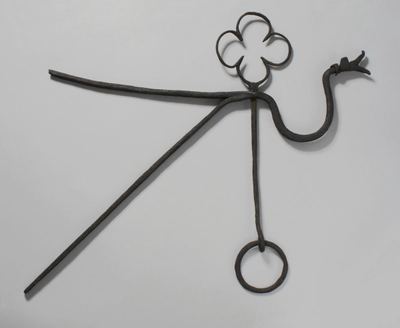
The Andiron and the Wall Bracket are both 14th-century Italian ironwork that entered the collection in 1908 through the Rogers Fund. They are objects that were actually used in the kitchen or in front of the fireplace.
Andirons are supports set up in facing pairs inside a fireplace to lift the firewood off the floor. Air has to flow underneath for the fire to catch well. Pots or spits were hung on the hooks at the top, so the andiron also served as a rack for cooking tools.
The wall bracket was fixed into the wall to hang a lamp, a pot or clothing. Both are practical objects, yet no decoration was spared. Fourteenth-century Italian blacksmiths put scrolls and animal heads even on andirons, and the quatrefoil on the wall bracket comes from the window tracery of Gothic architecture. The snake heads were shaped by hammering the iron. Objects made to be used had lines so fine that they ended up in a museum.
In the ironwork puzzles, bent iron bars cut across the image. Match the borders between the black iron and the white or gray background first, then continue along the curves. The museum image of the andiron is black and white, so you have to sort pieces by differences in brightness.
Islamic patterns covering Spanish walls
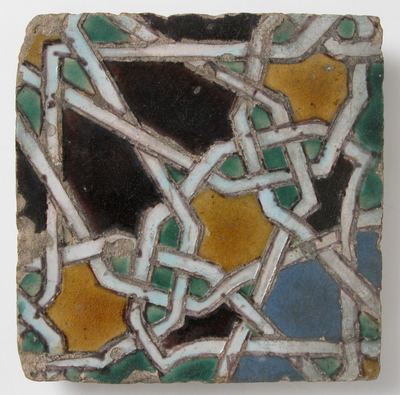
The two Wall Tiles are earthenware tiles fired in 15th-century Spain. Both entered the collection as a “Gift of Garrett Chatfield Pier, 1908.”
On the large tile, the geometric pattern of interlacing bands comes from Islamic art. In 15th-century Spain, Mudéjar workshops (Muslim craftsmen who remained under Christian rule) fired such patterns into ceramic tiles and covered the walls of palaces and churches with them. The Met’s records give the place of manufacture for both as “Seville or Toledo.” Each tile carries only part of the pattern, so when many tiles are joined, the pattern continues endlessly.
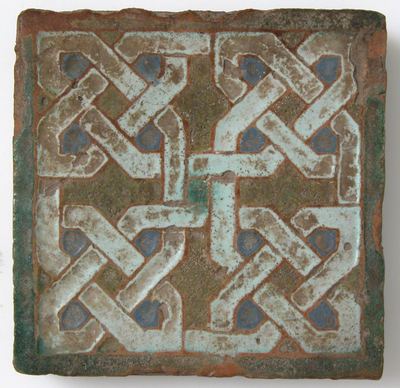
The small tile is from the same time and region, but its pattern is simpler. Small tiles like this filled the bands and corners between the large tiles. The blue dots are cobalt glaze, an expensive color at the time. The large patterns and the small ones filling the spaces between them made up a wall together.
It is worth noting that the architectural decoration of Christian Spain used Islamic patterns as they were. The white knotted band on the small tile is another pattern absorbed in this way. On the wall, two cultures of different religions mixed without hesitation.
The tiles are tricky because the interlacing band pattern makes the pieces look alike. As discussed in why repeating patterns are hard, starting from the four corners gives you the overall structure.
Stone from Athens in a Venetian wall
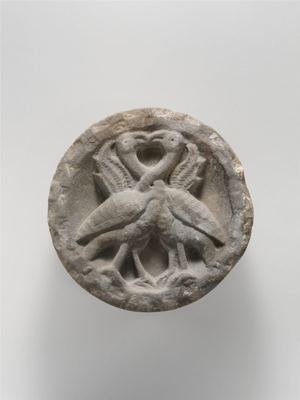
On the Decorative Roundel, two birds stand facing each other with their necks crossed. Two birds with crossed necks is a motif that came to Venice from Byzantium, and in 12th- and 13th-century Venice it was fashionable to set roundels like this into palace walls. The two birds are said to stand for harmony or a married couple.
Even more surprising is where the stone came from. The museum’s records identify this marble as Pentelic marble quarried on Mount Pentelikon near Athens. Pentelic marble is the stone used to build ancient Greek temples, so it is possible that stone taken from an older building was reused. If that guess is right, stone that once formed part of a Greek temple somehow made its way to Venice and, centuries later, decorated a palace wall.
The most distinctive part of the roundel is the center, where the two birds’ necks meet, so start there. As for piece counts, 24 to 48 pieces suits the ironwork and the small tile, and 48 pieces suits the large tile and the roundel.
Even on things for lighting fires and hanging lamps
None of the five carries a saint’s face or a king’s name. They are objects for lighting fires, hanging lamps and covering walls. Yet they are packed with scrolls, geometric patterns and symbols. If small medieval treasures shows the intricacy of objects held in the hand, these five show the decoration that filled the larger spaces of houses and buildings. The traces of Byzantium and Venice, Islam and Christian Spain exchanging patterns are easier to see alongside Byzantine gold coins.
Medieval art brings altarpieces and reliquaries to mind first, but what people of that time faced for the longest part of the day was probably the ironwork in the kitchen and the walls of their rooms. The fact that they put care into these too makes their daily lives feel closer than any religious painting.