Burnus / Selham
A hooded cloak woven of red-striped silk, a 19th-century example of the men's outer garment called a selham in Morocco. Full commentary ↓
Couldn't load the puzzle image.
Turn on piece outlines to see piece positions on this picture too
Drag the pieces into place · When zoomed in, drag an empty spot to move around
You can also play with a keyboard — Tab to the board, thenSpace pick a piece, Arrow keys move it (with Shift for small steps),Esc deselect, R rotate a piece (Shift+R the other way)
Burnus / Selham is a textile by an unknown maker (19th century) in the collection of The Metropolitan Museum of Art.
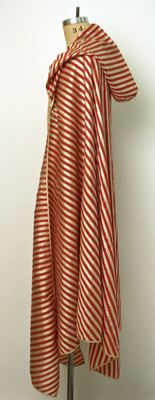
In the pictureA long cloak draped on a mannequin falls to the floor, with a pointed hood attached at the back. The fabric is silk with red and cream stripes running on a slant; there are no sleeves, and the front fastens only at the neck. The stripes fan out as they run down from the shoulders to the hem.
BackgroundSelham is the Moroccan name for the burnus, and those made of silk instead of wool were worn by wealthy city dwellers on formal occasions. Striped silk was woven in the workshops of cities such as Fez in Morocco, and the color and width of the stripes could even signal a family or region. A simple cut in a showy fabric is characteristic of men's clothing in this region.
Puzzle tipThe direction of the stripes is the key to the puzzle. Near the shoulders the stripes are almost vertical, and they grow more slanted toward the hem, so use the angle of the stripes on a piece to judge whether it belongs high or low. Fit the outlines of the mannequin's neck and the hood, and the curved hem pieces, first, and the rest becomes easier. 48 pieces is about right.
- Classification
- Outerwear
- Medium
- Silk; woven
- Dimensions
- Overall:
- Credit line
- Gift of Mrs. John Jay Whitehead, 1943
Source: The Metropolitan Museum of Art ↗
Stories about this work
- From Kurta to Cloak: Six Garments from the Islamic World, Told Apart by Shape
Even within Islamic-world dress, a different shape makes an entirely different garment. Six pieces, from two kurtas to a doll-sized wedding dress, sorted by form.