Château de Vouzan
Two round towers with conical blue roofs, flower beds and a curving dirt path: Burgy's vertical watercolor of the Château de Vouzan in the Charente, August 1888. Full commentary ↓
Couldn't load the puzzle image.
Turn on piece outlines to see piece positions on this picture too
Drag the pieces into place · When zoomed in, drag an empty spot to move around
You can also play with a keyboard — Tab to the board, thenSpace pick a piece, Arrow keys move it (with Shift for small steps),Esc deselect, R rotate a piece (Shift+R the other way)
Château de Vouzan is a watercolor by Henry Victor Burgy (1888) in the collection of The Metropolitan Museum of Art. It measures 24.1 × 16.2 cm.
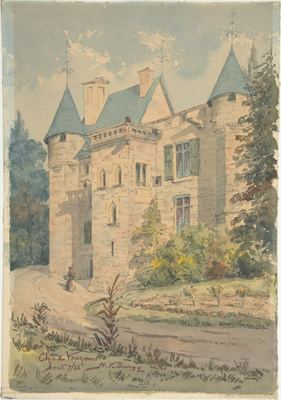
In the pictureTwo round towers topped with conical blue slate roofs stand on either side, and between them rises a central building with two tall chimneys and a balustrade. Each tower top has a weathervane, and on the right wall is a window with its green shutters open. In front of the cream stone walls run yellow and green shrubs, flower beds in bloom and a curving dirt path, and on the path below the left tower a woman carrying a basket stands, small. Dark trees enclose both sides, and on the grass at the bottom is the reddish-brown inscription 'Chau de Vouzan Aout 7/88 H.V. Burgy'.
BackgroundVouzan is a village in the Charente region of western France. Going by the inscription at the bottom, it was painted on August 7, 1888. Whereas La Bocca and Antibes showed the Mediterranean coast in the winter of 1882, this painting captures a château inland in summer six years later. At 24.1×16.2cm it is the smallest of Burgy's three works, and the paper is turned upright to bring out the height of the towers. Round towers and steep conical roofs are a form commonly seen in French provincial châteaux. All three works entered the museum through the artist's bequest in 1901.
Puzzle tipThe colors form layers from top to bottom: blue roofs, cream walls, green shrubs and the dirt path. Fitting the conical roofs, weathervanes and chimney pieces of the two towers first sets the upper outline. Next come the straight lines of the windows and green shutters, and the dark trees on either side. Place the flower beds and path at the bottom using the red inscription pieces, and fill the sky with its scattered white clouds last. 48 pieces is about right.
- Artist
- French, died 1901
- Classification
- Drawings
- Medium
- Watercolor
- Dimensions
- 24.1 x 16.2cm
- Credit line
- Bequest of H. V. Burgy, 1901
Source: The Metropolitan Museum of Art ↗
Stories about this work
- Three French Watercolors by Burgy, Who Recorded His Travels with a Brush
A beach near Cannes, the ramparts of Antibes, an old château in the Charente. Three watercolor landscapes left by the little-known Burgy as he traveled 19th-century France.