Three French Watercolors by Burgy, Who Recorded His Travels with a Brush
Published
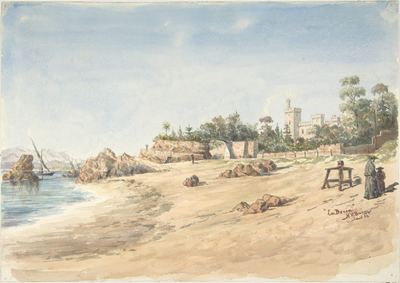
A sandy beach west of Cannes, and in the right corner one small person sitting at an easel. Among the famous names in the Drawings and Prints section is an unfamiliar artist: Henry Victor Burgy. The museum’s record says only “French, died 1901.” All three of his watercolors came to the museum as a bequest when he died.
| Work | Place | Date | Size |
|---|---|---|---|
| La Bocca | A beach near Cannes | 1882 | 24.1 × 32.4 cm |
| Antibes | A port town between Nice and Cannes | 1882 | 32.4 × 24.5 cm |
| Château de Vouzan | The Charente region of western France | 1888 | 24.1 × 16.2 cm |
All three have the same provenance: “Bequest of H.V. Burgy, 1901.” The artist entrusted his own pictures to the museum before he left.
The small person at the easel
 Solve this painting as a puzzle → about 5 minutes on Easy
La Bocca is a landscape of a sandy beach, red rocks, and a villa with a tower. It is a seaside village west of Cannes in the south of France. In the late 19th century Burgy traveled through southern and western France, leaving watercolor landscapes like this one.
The figure at the easel on the right appears to be the artist himself, added as someone painting outdoors. If so, the small person in the picture may be Burgy himself, painting this very picture. Slipping himself into one corner of the landscape is a playful touch typical of a painter who works as he travels.
Antibes before Picasso
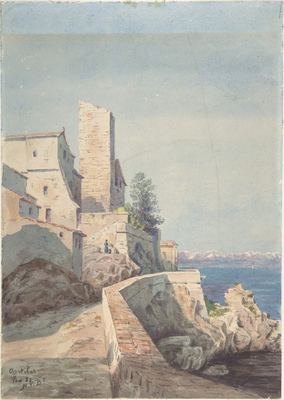
In Antibes, the Mediterranean and the snow-covered Alps appear beyond old houses on the ramparts. This old port town between Nice and Cannes was famous for the view of the Alps from its sea walls.
In 1882, when Burgy painted this, Antibes was still a fishing village. Picasso’s stay at the château and the museum that later opened there came afterward. The picture captures, in effect, the face of a town now known for its Picasso Museum before it became famous. A composition that puts snowy mountains and the sea in one frame is also the shortest way to sum up the town.
Place and date written below the picture
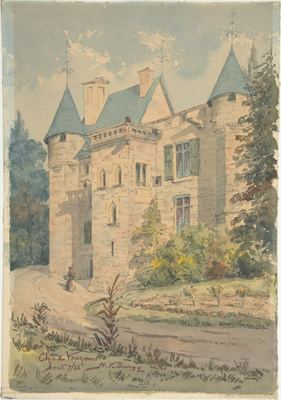
Château de Vouzan is a château in western France with round towers topped by blue roofs. It is a 15th–16th century manor in the Charente region, and its round towers and steep roofs are typical of the area’s châteaux.
Burgy painted provincial châteaux and villages like this as if keeping a record, and he often wrote the place and date below the picture. A moment that today would end with one quick phone photo, he preserved with brush and paint. Judging by how faithfully he noted places and dates, he seems to have thought of these pictures as travel records before thinking of them as works of art.
The south in 1882, the west in 1888
Little is known about Burgy. The surviving records give no year of birth; “French, died 1901” is all there is. He was probably not a famous painter. Even so, his three watercolors still carry Cannes and Antibes in 1882 and the Charente in 1888 down to us.
Put the three side by side and you can trace the route of one man traveling around France over several years: the southern Mediterranean coast in 1882, the western interior in 1888. Though he made no effort to make a name for himself, his landscapes have become testimony to an era.
Save the pale sky for later
All three share the pale tones typical of light watercolor, so they solve in similar ways. The pale blue sky is wide, so first separate sky from land (or sea) along the horizon or the outline of the ramparts, then build the skeleton of the picture from the straight lines of towers, walls, and roofs. Small figures like the person at the easel in La Bocca are easy to overlook, but they are the pieces with the sharpest shapes in the picture, which makes them good reference points. The distant Alps in Antibes mix white with pale colors, so they are best filled in last. The tips for choosing and solving pale landscapes in How to choose a landscape puzzle fit well here, and 48 to 100 pieces is the recommended size. For more works on paper from the same section, continue with Drawings by Degas and Lautrec.
In the days when cameras were rare, people like Burgy recorded the places they visited by drawing them. As you solve the three one after another, the moments when a traveler some 130 years ago stopped and took out his brush come back to your fingertips one by one. That small person sitting at the easel in the corner of La Bocca may well have been that traveler.