The Hamlet of Optevoz
Daubigny's drawing of about 1852: gabled cottages and great trees by a pond in charcoal, with clouds dabbed in white paint. Full commentary ↓
Couldn't load the puzzle image.
Turn on piece outlines to see piece positions on this picture too
Drag the pieces into place · When zoomed in, drag an empty spot to move around
You can also play with a keyboard — Tab to the board, thenSpace pick a piece, Arrow keys move it (with Shift for small steps),Esc deselect, R rotate a piece (Shift+R the other way)
The Hamlet of Optevoz is a drawing by Charles-François Daubigny (ca. 1852) in the collection of The Metropolitan Museum of Art. It measures 37.8 × 62.8 cm.
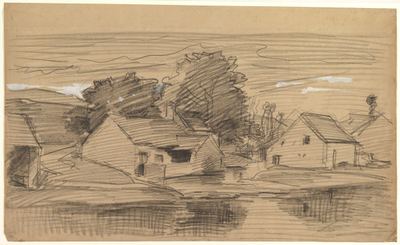
In the pictureOn tan paper, three or four low gabled cottages and two great masses of trees behind them are drawn in charcoal. The sky is filled with layer upon layer of long horizontal charcoal strokes, and white paint is dabbed over it at left and right to make a few clouds. The cottage on the right has a few small windows, and thin tree trunks stand beside it. In the pond in front, the shadows of the cottages and trees are reflected in vertical hatching, and the grass at the water's edge is done in short vertical lines. In the lower right corner there is a small red mark.
BackgroundOptevoz is a small village in the Isère region east of Lyon, a place Charles-François Daubigny (1817–1878) visited several times in the early 1850s to draw the village and its ponds. This drawing appears to have been a quick capture of forms on the spot around 1852, and it measures 37.8×62.8cm, more than 60cm wide. The only materials are charcoal and lead white (a white paint containing lead), and the tan of the paper serves as the middle tone. Daubigny is also famous for later fitting out a boat as a studio and painting as he traveled along rivers. It was acquired through the Rogers Fund in 1912.
Puzzle tipThe brightness divides into three: tan paper, dark areas of charcoal and white cloud dabs. Fit the two darkest masses of trees in the middle and the rooflines of the cottages first, then place one white cloud at left and one at right to set the height of the sky. The sky is horizontal hatching and the pond's reflections are vertical hatching, so the direction of the lines alone separates top from bottom. Because the drawing is wide, the pieces are flat; 48 pieces is about right.
- Artist
- French, Paris 1817–1878 Paris
- Classification
- Drawings
- Medium
- Charcoal and lead white
- Dimensions
- 37.8 x 62.8cm
- Credit line
- Rogers Fund, 1912
Source: The Metropolitan Museum of Art ↗
Stories about this work
- Village Sketches in Pen and Charcoal by Millet, Daubigny and Decamps
Millet, Daubigny, Decamps. Three painters known for their oils, and the country villages they set down quickly on paper. What you can see because these are not finished works.
- Why Forest Puzzles Are So Hard, and How to Choose a Landscape Painting
Landscapes with a wide sky and landscapes packed with forest are hard for different reasons. How to find reference points for each type, and how to pick a good first landscape.