Circus Sideshow (Parade de cirque)
Under gaslights, a trombonist plays on a circus sideshow stage while spectators stand in line in the dark: Seurat's only pointillist painting of a night scene. Full commentary ↓
Couldn't load the puzzle image.
Turn on piece outlines to see piece positions on this picture too
Drag the pieces into place · When zoomed in, drag an empty spot to move around
You can also play with a keyboard — Tab to the board, thenSpace pick a piece, Arrow keys move it (with Shift for small steps),Esc deselect, R rotate a piece (Shift+R the other way)
Circus Sideshow (Parade de cirque) is an oil painting by Georges Seurat (1887–88) in the collection of The Metropolitan Museum of Art. It measures 99.7 × 149.9 cm.
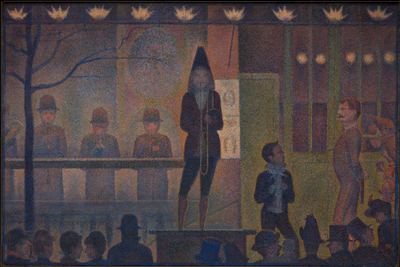
In the pictureA man playing the trombone stands in the middle of the stage, with musicians lined up in a row behind him. On the right is the ringmaster holding a cane, and on the left the backs and hats of the audience stretch out in the dark. Along the top, nine gaslights glow like scattered dots. The colors are built from dark dots of purple, brown and orange, and every figure is seen in profile or from behind.
BackgroundPainted in 1887–88, it shows a circus sideshow stage (parade) at a Paris spring fair. A parade is a free sample performance given outside the tent. It is one of Seurat's six major pointillist paintings and his only night scene, and its composition, with figures set sideways like those in an Egyptian relief, and its division of the canvas according to the golden ratio have long been subjects of study. What runs through it is not the noise of a fair but a strange stillness.
Puzzle tipAs a puzzle it is hard. The whole picture is dark pointillism, so sorting by color doesn't work well, and at small scale all the pieces look alike. Zooming in is essential. Start with shapes such as the bright dots of the gaslights, the trombonist's light face and the ringmaster's cane, then join pieces along the outlines of the figures' silhouettes. The grid pattern in the background (the railing) and the horizontal line (the front edge of the stage) are good clues. For a first try, 24 to 48 pieces is recommended.
- Artist
- French, Paris 1859–1891 Paris
- Classification
- Paintings
- Medium
- Oil on canvas
- Dimensions
- 99.7 x 149.9 cm
- Credit line
- Bequest of Stephen C. Clark, 1960
Source: The Metropolitan Museum of Art ↗
Stories about this work
- Seven Paris Paintings from 1874 to 1897, from Manet's Boating to Pissarro's Winter Boulevard
Twenty-three years, from Manet's Boating to Pissarro's Boulevard Montmartre. Following Impressionism's birth, its split, and the passage to the next generation through seven paintings. Plus how pointillism and blurred brushwork differ as puzzles.