Seven Paris Paintings from 1874 to 1897, from Manet's Boating to Pissarro's Winter Boulevard
Published
In 1874, the first Impressionist exhibition opened in Paris. At the eighth and last exhibition in 1886, Seurat’s pointillist painting was hung, and people laughed in front of it. In between, Impressionism was born, split apart, and made way for the next generation. Line up seven works from The Metropolitan Museum of Art in chronological order and you can grasp that flow. It is 23 years, from Manet’s Boating (1874) to Pissarro’s winter morning (1897).
| Work | Artist | Year | Puzzle difficulty |
|---|---|---|---|
| Boating | Edouard Manet | 1874 | Half blue water |
| The Dance Class | Edgar Degas | 1874 | Many clues, easy going |
| By the Seashore | Auguste Renoir | 1883 | Blurred background |
| Circus Sideshow (Parade de cirque) | Georges Seurat | 1887–88 | Dark pointillism, hardest |
| The Card Players | Paul Cézanne | 1890–92 | Sort into four colors |
| Ia Orana Maria (Hail Mary) | Paul Gauguin | 1891 | Rich colors, easy going |
| The Boulevard Montmartre on a Winter Morning | Camille Pissarro | 1897 | Pale colors, no pushover |
1874: Manet goes out to the river, Degas into the rehearsal room
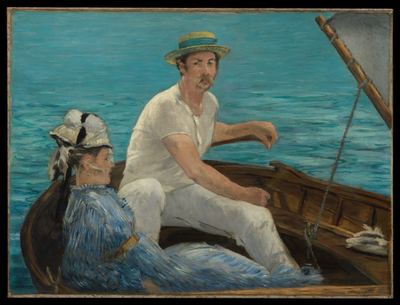 Solve this painting as a puzzle → about 5 minutes on Easy
In Boating, a man in white wearing a straw hat holds the sailboat’s rudder line and looks toward us. The woman beside him sits leaning against the gunwale, gazing into the distance. The boat is cut off at the bottom of the picture, and the rest is all blue water. With no horizon, the boat seems to float on the surface of the picture. This composition, filling the whole picture with water and no horizon, was borrowed from Japanese prints. It is a painting Manet, who had originally worked indoors, made in bright colors after going outside while staying with Monet in Argenteuil in the summer of 1874. When he showed it at the 1879 Salon, critics demanded, “Why is the water so blue?”
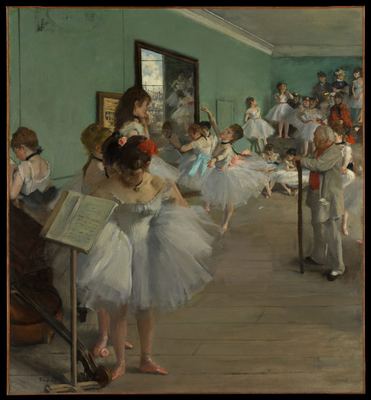
The same year, Degas went the other way, indoors. In the high-ceilinged rehearsal room of The Dance Class, more than twenty girls in white tutus are scattered about. In the middle, a white-haired old teacher leaning on a long cane watches one girl’s movements; he is Jules Perrot, the legendary choreographer of the Paris Opéra at the time. What drew Degas was not so much the performance on stage as the moments when dancers were not acting like dancers. Here, too, only one person is dancing, while the rest wait their turn, scratching their backs or fiddling with their ribbons. The watering can at lower left was used to sprinkle water on the floor to keep it from being slippery. Looking at Degas’s drawings as well gives a sense of how long he watched these girls.
1883: Renoir recovers the outline
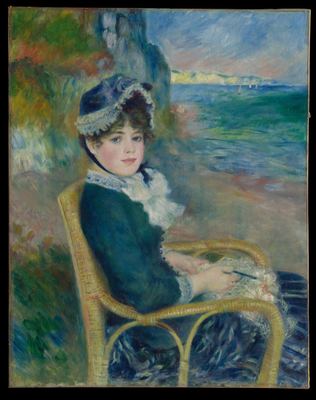
The woman in By the Seashore sits in a wicker chair. Wearing a blue dress and a hat and holding a fan, she looks toward us. Her face and hands are smooth and sharp, while the sea, cliffs, and sand behind her are smudged with short brushstrokes. The figure is painted as in a photograph, the background as in Impressionism. On a trip to Italy in 1881, Renoir looked again at Raphael and Ingres and felt, “I don’t know how to draw,” and afterward he turned toward reviving the outline. This painting stands at that crossroads, so the background is in the old manner and the figure in the new.
1887–92: Breaking into dots, building in planes
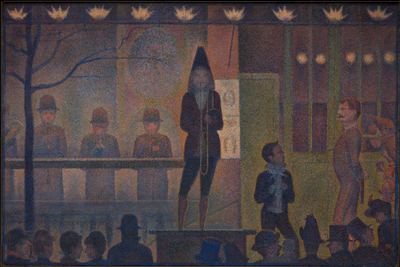
Circus Sideshow is a barker’s stage under gaslight. A trombone player performs, and the audience stands in rows in the darkness. A parade is the free sample performance shown outside the tent. It is one of Seurat’s six major pointillist paintings and his only night scene. The figures, without exception, are shown in profile or from behind, standing stiffly upright like Egyptian reliefs. Instead of festive noise, a strange stillness hangs over the scene.
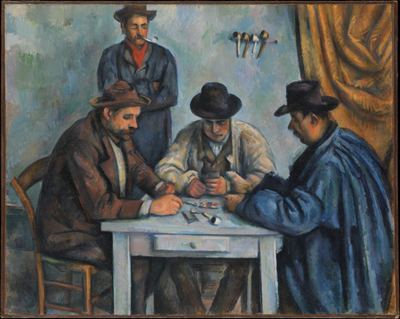
In The Card Players, three peasants sit around a table studying their cards while a man with a pipe stands behind them and watches. Cézanne painted this subject five times, using peasants near his home in Aix-en-Provence as models, and later pared it down to smaller versions with only two men facing each other (in the Musée d’Orsay in Paris and the Courtauld in London, among others). The usual reading is that what the painting holds onto is not the tension of the game but the balance of the forms the figures create. The colors, brown, blue, white and an orange curtain, are applied in broad planes. If Seurat broke color into dots, Cézanne built it up in planes.
1891–97: Tahiti and a hotel window
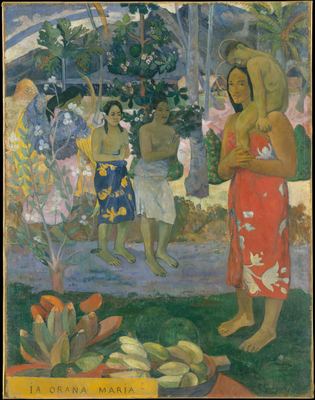
Ia Orana Maria is a religious painting Gauguin made in 1891, the year he arrived in Tahiti. The title means “Hail Mary” in Tahitian. A Tahitian woman wrapped in a red pareo stands with a child on her shoulder, and thin halos float above both their heads. On the left is an angel with yellow wings, and in front of it two women press their palms together. This pose was taken from a photograph of reliefs at the Borobudur temple in Java. Gauguin considered this painting the best of his Tahitian works, but he was disappointed when it did not sell in Paris.
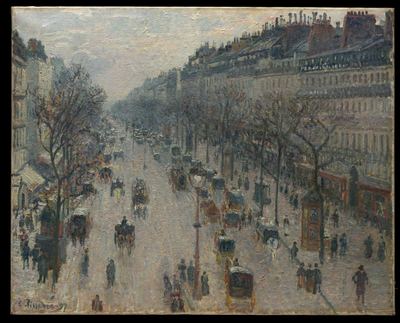
In February 1897, Pissarro rented a hotel room overlooking the boulevard. Then, over two months, from the same window, he captured morning, afternoon, night, rain, snow, and festivities in fourteen paintings. The Boulevard Montmartre on a Winter Morning is one of them. It was the method found by a sixty-seven-year-old painter for whom an eye ailment had made working outdoors a struggle. Carriages and people scatter as black dots, and everything is steeped in the hazy light of a winter morning. Pissarro was the only painter who exhibited at all eight Impressionist exhibitions without fail, from the first to the last.
Brushwork is difficulty
If you take “how well the colors separate,” as described in the difficulty guide, as the yardstick, the seven paintings fall into three groups.
Gauguin, Cézanne, and Degas have distinct colors. Gauguin separates at once into a red pareo, yellow wings, blue clothing, green leaves, and purple mountains, and for Cézanne four colors, blue, ocher, yellow, and brown, are all you need. Degas has a lot of white tutus, but each girl’s ribbon is a different color, so they can be told apart. All three are manageable even at 300 pieces.
In Manet and Renoir, a single color takes up half the picture. Manet’s blue water finds its place by the grain of short horizontal brushstrokes and by brightness; near the figures there is a very slight hint of green, and toward the top a slight tinge of purple, which you can see only by zooming in. For Renoir, leave the blurred background for last and fill it in using the border where the sea at the top meets the sand at the bottom as your reference.
The trickiest are Seurat and Pissarro. When you zoom out on Seurat’s dark pointillism, all the pieces look alike. Grab the places that have form first, such as the bright dots of the gaslights or the trombone player’s bright face, then join pieces along the outlines of the figures’ silhouettes. If it is your first time, 24–48 pieces is good. Pissarro’s colors are pale and much alike, so set up the skeleton first with the bright diagonal band of the boulevard and the edges of the buildings on both sides, then fill the boulevard with pieces that have the black dots of carriages and people. If you still get stuck, it is better to step back for a moment and come back, as I said in the post on getting stuck.
The next generation
Other painters were in Paris during these 23 years as well. Van Gogh, who was in Paris in the same period, is gathered separately in six paintings, and Lautrec, the generation after these paintings, can be met in two Yvette Guilberts. From the year Manet’s boat floated without a horizon to the winter when Pissarro was fixed at his window, each painter went out or came in, searching for the next painting.
Frequently asked questions
Which Impressionist painting is hardest as a puzzle?
Seurat's Circus Sideshow and Pissarro's The Boulevard Montmartre on a Winter Morning. Seurat's is dark pointillism, so when zoomed out all the pieces look alike and zooming in is essential, while Pissarro's colors are pale and similar. By contrast, Gauguin, Cézanne, and Degas have distinct colors, so even 300 pieces is manageable.
Why is there no horizon in Manet's Boating?
The composition that fills the whole picture with water and no horizon came from Japanese prints. It was painted outdoors in the summer of 1874, when Manet was staying with Monet in Argenteuil, and at the 1879 Salon critics asked, "Why is the water so blue?"
Which painter took part in all eight Impressionist exhibitions?
Camille Pissarro. He was the only painter who exhibited at every one, from the first exhibition in 1874 to the last in 1886.