Cuirassier
A cuirassier standing with his sword before a black horse, in a red-plumed helmet, silver breastplate, white breeches, and black boots. A watercolor by Detaille, 1872. Full commentary ↓
Couldn't load the puzzle image.
Turn on piece outlines to see piece positions on this picture too
Drag the pieces into place · When zoomed in, drag an empty spot to move around
You can also play with a keyboard — Tab to the board, thenSpace pick a piece, Arrow keys move it (with Shift for small steps),Esc deselect, R rotate a piece (Shift+R the other way)
Cuirassier is a watercolor by Edouard Detaille (1872) in the collection of The Metropolitan Museum of Art. It measures 25.7 × 17.8 cm.
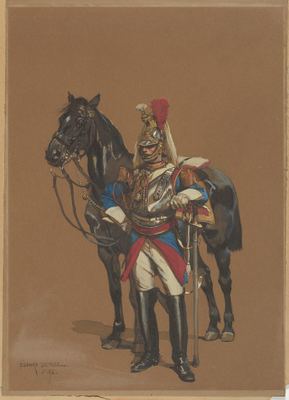
In the pictureOn brown paper, a single cuirassier stands facing forward with a black horse behind him. His helmet carries a red plume, a small white plume, and a pale horsehair tail hanging down his back; below the silver breastplate show a blue sleeve, a red sash, and red coattails. One white-gloved hand rests on the hilt of a long sword planted on the ground, and the other holds the reins against his hip. Below his white breeches he wears black boots that reach the knee. The horse wears a bridle and turns its head to the left, and the background is left as the bare color of the paper. The signature "EDOUARD DETAILLE 1872" is at the lower left.
BackgroundEdouard Detaille (1848–1912) was a Paris painter who studied with Meissonier and became known for military pictures that reproduced uniforms and equipment precisely. 1872 was the year after France lost the Franco-Prussian War, and the armored heavy cavalry are famous for the heavy losses they suffered in that war's charges. This 25.7×17.8cm watercolor is closer to a record showing one soldier's dress from head to toe. A watercolor of a mounted cuirassier from the same year is also on this site, but the two arrived by different routes: that one through the Wolfe bequest in 1887, this one in 1914 as part of Morris K. Jesup's collection, bequeathed by his wife.
Puzzle tipThe black horse, silver breastplate, red plume and coattails, and white breeches are clearly separated by color. Assemble the red plume of the helmet, the face, and the bridle on the horse's head first, then connect the upper body with the breastplate and blue sleeve. At the bottom, the two black boots, the horse's four legs, and the sword tip touching the ground are the reference points. Fill the wide brown background from the edges after placing the signature at the lower left and the shadow under the feet. 48 pieces is a good fit.
- Artist
- French, Paris 1848–1912 Paris
- Classification
- Drawings
- Medium
- Watercolor on paper
- Dimensions
- 25.7 x 17.8cm
- Credit line
- Bequest of Maria DeWitt Jesup, from the collection of her husband, Morris K. Jesup, 1914
Source: The Metropolitan Museum of Art ↗
Stories about this work
- Three Cavalry Pictures by Detaille, Who Collected Real Uniforms
Edouard Detaille painted while collecting real military uniforms. A record of uniforms in three works: on horseback, dismounted, and on a peaceful march.