Three Cavalry Pictures by Detaille, Who Collected Real Uniforms
Published
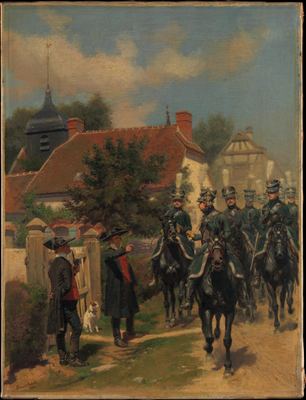
Cavalrymen in green uniforms file past between red-roofed houses, and villagers stand at their doors watching the procession. This is a painting by the 19th-century French painter Edouard Detaille (1848–1912). Here we look at three of his works together: one oil painting and two watercolors. They entered the collection by different routes, but all of them depict soldiers and uniforms.
The painter who collected uniforms
Detaille was known for reproducing historical uniforms accurately, and his paintings were actually used as reference material on military dress. To paint the army’s clothing correctly, he went as far as collecting real uniforms. That collection later became the foundation of the Army Museum in Paris.
It is not unusual for a painter to gather reference material. It is a different story when that material piles up enough to form a museum. For Detaille, painting was closer to record-keeping than to imagination.
A cavalry procession passing through a village
 Solve this painting as a puzzle → about 5 minutes on Easy
The painting described at the start is Gendarmes d’Ordonnance. Of the three, it is the only oil painting. Cavalrymen pass along a village street where a church bell tower stands, and the residents watch them.
This unit is said to have been a cavalry corps made up of sons of noble families that existed briefly in the Napoleonic era. Choosing a peaceful march through a village over a battle scene is characteristic of Detaille. In the 1890s he liked to paint everyday scenes of army life, and here he put even the gaze of the villagers into a single picture.
In the puzzle, color is your guide. The green uniforms, red roofs, and blue sky separate clearly, so divide the picture into color zones first. Then connect the pieces by following the line of the procession. Between 48 and 100 pieces is right.
On the horse and off it: a pair of watercolors
The other two are a pair of watercolors painted in the same year.
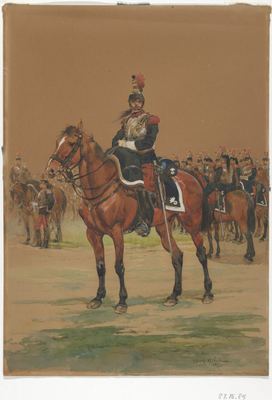
In French Cuirassier, a cavalryman in a silver cuirass and a helmet with a red plume rides a horse on brown paper.
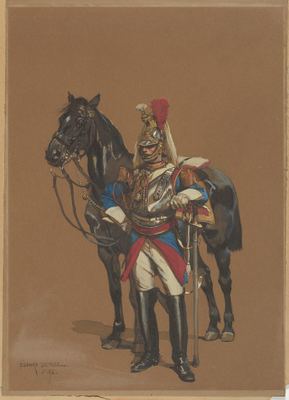
In Cuirassier, a cavalryman in the same outfit has dismounted and stands holding the reins. These two pictures in the same museum show the mounted and dismounted figure side by side, recording the uniform and equipment front and back. One sheet holds the posture on horseback and the saddle equipment; the other holds the trousers and boots when standing and the place where the sword hangs. They are like the front and back views in a field guide.
A branch of service that lost its power before the gun
The cuirassier was a heavy cavalryman who fought with steel plates on chest and back. It was the branch of service that symbolized the Napoleonic era. In the Franco-Prussian War of 1870, that armor was powerless against guns. As firearms developed, cavalry could no longer exert the force it once had.
Detaille painted these two watercolors in 1872, right after the war. He may have wanted to make one last accurate record of a branch of service in decline. Building light by laying white on brown paper is a method often seen in his watercolors.
Because most of the background in the two cuirassier pictures is the bare color of the paper, they are assembled differently from an oil painting. As discussed in Degas and Lautrec drawings, it is faster to first separate the pieces with painted color (silver cuirass, red plume, green grass) from the pieces that are only paper color. Mounted or not, the horse’s legs and body are the central axis of the picture, so if you catch that outline first, the cavalryman’s place follows. In French Cuirassier, the group of cavalry lined up faintly in the background is where the shapes are vaguest, so you can leave it for last. These are small watercolors, so 24 to 48 pieces is enough.
The army in society, one man’s uniform
Set the three side by side and two ways Detaille looked at the army come out. The large oil painting depicts the moment when the army meets a village. The two small watercolors try to record one man’s uniform, front and back, leaving nothing out. One painter had both eyes.
Dudley’s series depicting the laying of the Atlantic cable also came from an attitude of accurately recording something that really happened. That series recorded an industrial achievement; Detaille recorded a vanishing branch of service. How to read pictures that tell a story is also covered in Learning to look at art through puzzles. The fact that, just as steel armor was losing its usefulness, someone drew it carefully front and back makes these pictures worth looking at longer.