Embroidered sampler
A sampler of about 1761 with three short verses stitched among deer, trees, and flower baskets. The name of its maker does not survive. Full commentary ↓
Couldn't load the puzzle image.
Turn on piece outlines to see piece positions on this picture too
Drag the pieces into place · When zoomed in, drag an empty spot to move around
You can also play with a keyboard — Tab to the board, thenSpace pick a piece, Arrow keys move it (with Shift for small steps),Esc deselect, R rotate a piece (Shift+R the other way)
Embroidered sampler is a textile by an unknown maker (ca. 1761) in the collection of The Metropolitan Museum of Art. It measures 36.2 × 31.4 cm.
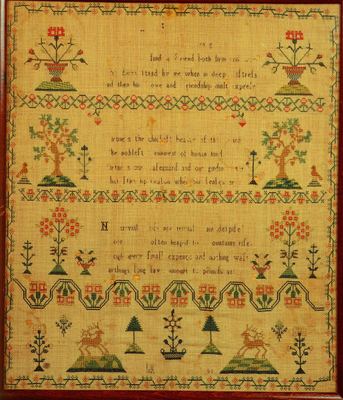
In the pictureOn yellowed linen, bands of red flowering vine divide the picture horizontally into three sections, and each section is embroidered with a few lines of verse, trees, flower baskets, and small figures. In the bottom section two deer stand among trees. The thread colors are mainly red, green, and yellow, somewhat faded with time.
BackgroundIn the mid-18th century, English samplers were in the process of changing from alphabet practice pieces into decorative works with verses and pictures. The verses are common moral poems praising friendship and virtue, and the deer and trees are stock images from the pattern books of the day. There is no name or age, either because that part was cut away or because none was included in the first place.
Puzzle tipThree horizontal bands of red vine serve as guides for dividing the picture. Fit the band pieces first to form the sections, place pieces with distinct shapes, such as the deer and trees, in each section, and then judge the lettering pieces top from bottom by the spacing of the lines. 100 pieces suits it.
- Classification
- Textiles
- Medium
- Silk on linen, embroidered
- Dimensions
- 36.2 x 31.4 cm
- Credit line
- Gift of Mrs. Henry Stockwell Gibson, 1936
Source: The Metropolitan Museum of Art ↗
Stories about this work
- Two Spoons and a Nameless Deer Sampler
Pewter spoons from a household that could not afford silver, and a 1761 embroidered sampler whose name was cut away. The last two works that fit no category.
- Why Dogs and Horses Turn Up So Often in Old Master Paintings
Animals in old paintings were both decoration and symbol: the dog for loyalty, the horse for status and authority, the bird for freedom and the soul. Small supporting players you find while doing the puzzle.
Puzzles to try next
More European Embroidery & Costume puzzles· Stories and puzzle tips