Why Dogs and Horses Turn Up So Often in Old Master Paintings
Published · updated
A boy holds a small black dog up against his chest, and the dog, its pink tongue just showing, looks up toward us. On first viewing you see only the boy’s face, but as you assemble the puzzle, the dog is what catches your eye first. Animals in the corners are usually discovered late like that. Even the same dog or the same horse does a different job from painting to painting. Some animals simply sit nearby, some are essential to the story, and some serve as markers that point to a person’s rank or to a god.
The dog in a portrait usually means something
For a long time the dog symbolized faithfulness and loyalty, so when a dog sits in an old portrait, it is hard to pass over. A dog in a marriage portrait pointed to marital fidelity; a hunting dog in an aristocrat’s portrait pointed to rank and pastimes.
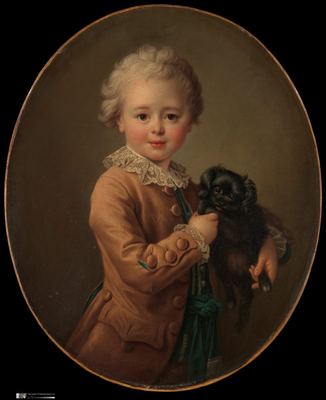 Solve this painting as a puzzle → about 5 minutes on Easy
Portraits of a child with a dog are especially common. The child’s innocence and the dog’s devotion overlap, so painters liked the pairing. Yet the dog in Boy with a Black Spaniel looks more like a friend than a symbol. The boy supports the dog at his chest with one hand and wraps his other arm around its body. The dog looks straight up at the viewer.
In the puzzle, this dog can be both a reference point and a trap. It separates clearly from the boy’s apricot coat, but it is almost the same darkness as the dark olive background, so placing it by outline alone is hard. Use the brown eyes, the pink tongue, and the white claw tips of the dangling hind paw as clues. Outside the oval is the black of the photographic background, so the four corner pieces are solid black. In the lower left corner the museum’s color calibration target is printed, so that one piece is quick to find.
Some dogs play their own part in the story. In Neri di Bicci’s small The Archangel Raphael and Tobias, a little dog follows the boy who walks holding the angel’s hand. This is the dog that set out with Tobias in the Book of Tobit, from the Old Testament Apocrypha. The larger version of the same subject has no dog, and why is covered in The same painting at two prices.
The gray hunting dog in Diana is a marker that lets you recognize the goddess of the hunt. The dog in Card Players in a Drawing Room, by contrast, has nothing to do with the story. It simply sits small on the floor at lower right. That indifference is what makes the room feel truly lived in. Assembled at 100 pieces (11 across, 9 down), the dog is about the size of a single piece.
The horse was a sign of power, but
A figure on horseback was usually a commander or a nobleman, and in old paintings the horse long stood for power and rank. Still, the horses gathered here each do a slightly different job.
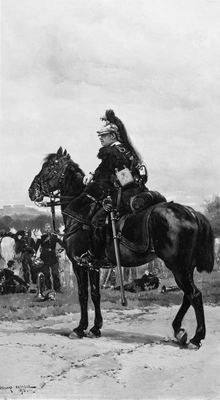
The horse in A Dragoon on Horseback is closer to a line in an equipment list than a statement of rank. Edouard Detaille made his name as a painter of exact uniforms and equipment, and on this small panel, less than 14 cm wide, he treated the horse with the same care. You can see the leather straps and metal fittings of the bridle, the coat rolled up behind the saddle, lettering like a unit number on the canteen, and the hilt of the saber, and under the raised hind hoof you can even see the horseshoe.
Because the image is black and white, you have to solve it by brightness instead of color. The horse’s body is a large dark mass and the sky is light gray, so the outline is clear. The problem is that the inside of the body is a single darkness. Find positions by looking at the edge of the saddle, the mane, and the joints of the legs. Nearly the upper half is cloudy sky and the bottom quarter is a sandy road, so the horse hangs like a band across the middle of the picture.
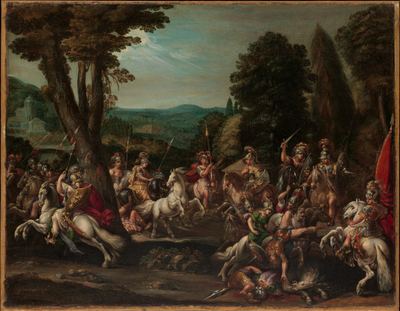
The horses in Triumph of the Amazons are there for movement rather than status. Several white horses rearing on their front legs are scattered across the left, center, and right of the picture, and at lower right you can see the head of a fallen horse. It was painted by Claude Déruet, court painter to the Duke of Lorraine, and its companion piece is Departure of the Amazons. For a painter of that time, skill at painting horses was an important ability.
In this painting, start with the white horses. They are the brightest and largest shapes in the dark forest, so once they are in place, the picture divides into three zones. The brown and black horses blend easily into the trees and ground. Thin parts like the legs only partly cross any one piece, which makes them hard to recognize.
In Joseon dynasty portraits, the job the horse does in Western painting is done by the rank badge on the chest. The badge in Portrait of Yun Dongseom is embroidered with two cranes, the insignia of a senior civil official. This painting is covered in more detail in the Korean painting puzzle guide.
The bird’s meaning changes with context
In religious paintings the dove was often the Holy Spirit, a bird in a cage was confinement, and a bird in flight was the soul or freedom.
Birds appear as often in embroidered samplers and textiles as in paintings. Part of the reason birds and flowers never go missing from samplers stitched by girls is that the designs were simple and good for filling space. In Hannah Bloomfield’s sampler, birds stand facing each other in pairs on either side of a vase, and below, one large bird spreads its wings. Anne Fazackerley’s sampler has a cow beside a red house and a small dog at a man’s feet. These are closer to shapes copied from pattern books of the time than to symbols. In the sampler from around 1761, whose maker’s name has not survived, two deer stand among trees in the bottom row.
What you miss if you look for a few seconds and move on
These animals are not the subjects of the paintings. If you glance for a few seconds in a museum and walk on, you will almost certainly miss them.
A puzzle does not let you do that. You have to pass through every corner of the picture at least once before you finish, so while fitting background pieces there always comes a moment of “there was a dog here.” That, in the end, is why a puzzle becomes a way of looking at art, and in portrait puzzles such discoveries are especially frequent. The story of the dragoon and the boy, which Detaille and Drouais painted differently from their usual work, continues in Neither uniforms nor ladies. When you look at who was painted alongside the main figure, you can see a little more of how the painter wanted that person to appear.