Two Spoons and a Nameless Deer Sampler
Published
Two pewter spoons stamped with initials at the end of the handle. And one embroidered sampler whose maker’s name has not survived. We have written several posts about clothing and embroidery, but these two works did not fit neatly into any category. Their materials and eras differ, but they share one thing: because they are not showy, they draw the eye all the more.
| Work | Material | Date |
|---|---|---|
| Spoon | Pewter | 1700–1800 |
| Embroidered sampler | Silk, linen | ca. 1761 |
Spoons from a Household That Could Not Afford Silver
 Solve this painting as a puzzle → about 5 minutes on Easy
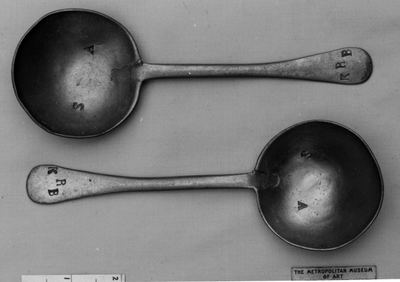
Spoon is a black-and-white photograph. Two spoons with round bowls and flat handles lie side by side, with initials stamped at the end of the handles and inside the bowls. The surfaces bear scratches from long use.
Pewter is an alloy of tin mixed with lead or copper. It was much cheaper than silver and had a low melting point, so it could easily be cast in molds. Ordinary households in 18th-century Europe and America used pewter for plates, spoons and cups, stamping them with initials to mark whose they were. It is a material that turns soft and dented with long use, so pieces surviving as intact as these are rare.
Most of the other works here are objects made to be looked at, like embroidery or paintings. These spoons were made simply to be used. That is exactly why they show the 18th-century ordinary person’s table most directly.
As a puzzle, it is black and white with a plain background, so you have to rely on shape alone. Assemble the round bowls of the two spoons, the straight pieces of the handles and the ruler and label pieces at the bottom first, then fill in the empty background last. We recommend 24 pieces.
Embroidery with Its Name Cut Away
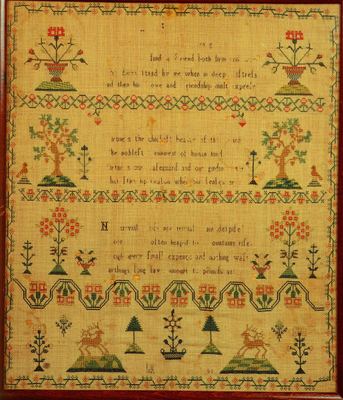
In Embroidered sampler, bands of red flowering vine run horizontally across yellowish linen, dividing the picture into three sections. Each section is embroidered with a few lines of verse, trees, flower baskets and small figures, and in the bottom section two deer stand among trees. The five samplers from 1735 to 1823 were cases in which the maker’s name survived. This sampler has neither a name nor an age. Either that part was cut away or it was never included in the first place.
In mid-18th-century England, samplers were shifting from alphabet practice pieces to decorative works holding verse and pictures. The verse is a common moral poem praising friendship and virtue, and the deer and trees are standard motifs from the pattern books of the time. The history of the sampler as an object is covered in The Story of the Embroidered Sampler. Missing a name does not make it any less carefully made. It is only that for this one piece, there is no way to trace who made it or at what age.
The three red vine bands are your reference for dividing the picture. Assemble the band pieces first to create the sections, place pieces with recognizable shapes such as the deer and trees in each section, then decide the top and bottom of the lettering pieces by the line spacing. 100 pieces is about right.
What Remains Because It Is Not Showy
Both works are modest compared with the others. They have no gold thread, no jewels and no famous painter’s name. Yet things like these are the closest to what ordinary people of the time actually held in their hands and lived with. As everyday objects, they also have something in common with medieval everyday objects.
Over the last several posts we have been seeking out works not yet covered, and with these two, one full round comes to an end for now. Remembering that nearly half the works are by an unknown artist, it seems fitting to close with a nameless sampler and spoons that bear only initials. Among the splendid wedding garments and court robes, the traces of people who lived ordinary days also hold their place like this.