Embroidered sampler of the Queen's House, Greenwich
A 1777 sampler embroidering the Queen's House, Greenwich, with carriages, gardens and strollers: needlework that goes beyond practice to become a picture. Full commentary ↓
Couldn't load the puzzle image.
Turn on piece outlines to see piece positions on this picture too
Drag the pieces into place · When zoomed in, drag an empty spot to move around
You can also play with a keyboard — Tab to the board, thenSpace pick a piece, Arrow keys move it (with Shift for small steps),Esc deselect, R rotate a piece (Shift+R the other way)
Embroidered sampler of the Queen's House, Greenwich is a textile by an unknown maker (1777) in the collection of The Metropolitan Museum of Art. It measures 44.5 × 38.1 cm.
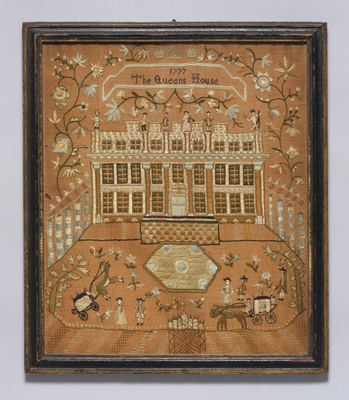
In the pictureOn a brown ground fabric, a building with rows of white windows is embroidered head-on, and above it are the words "The Queens House 1777." Below the building, a garden and walkways, carriages and horses, and people walking with dogs are set out in small scale, and on both sides vines bearing flowers and fruit frame the picture.
BackgroundSamplers were practice cloths that girls made while learning stitches and the alphabet, but in late 18th-century England, pieces like this that embroidered a real building like a picture were in fashion. The Queen's House shown here is the royal residence at Greenwich designed by the architect Inigo Jones in the early 17th century, regarded as England's first classical building. The maker's name does not survive, but since even the number of windows and the roof ornaments match, it was clearly made from the real building or a print.
Puzzle tipAs a puzzle, it divides into three areas: the grid of white windows on the building, the small figures and carriages in the garden below, and the vine borders on both sides. The windows are regular and can be confusing, so count the floors using the roof and the ground-floor door as references, and tell the left and right vines apart by the colors of their flowers.
- Classification
- Textiles-Embroidered
- Medium
- Silk on linen
- Dimensions
- 44.5 x 38.1 cm
- Credit line
- Gift of Barbara Schiff Sinauer, 1984
Source: The Metropolitan Museum of Art ↗
Stories about this work
- From 1735 to 1823: Five Signed Embroidered Samplers and One Building
From 13-year-old Mary Pearce to 6-year-old Harriott Cates, five English embroidered samplers spanning 90 years, plus one exception that stitched a building instead of a name.
Puzzles to try next
More European Embroidery & Costume puzzles· Stories and puzzle tips