Dress
A late 19th-century woman's dress of ivory wool with vertical black cord trim, a tasseled collar and cuffs embroidered with flowers. Full commentary ↓
Couldn't load the puzzle image.
Turn on piece outlines to see piece positions on this picture too
Drag the pieces into place · When zoomed in, drag an empty spot to move around
You can also play with a keyboard — Tab to the board, thenSpace pick a piece, Arrow keys move it (with Shift for small steps),Esc deselect, R rotate a piece (Shift+R the other way)
Dress is a textile by an unknown maker (late 19th century) in the collection of The Metropolitan Museum of Art. It measures 139.7 cm.
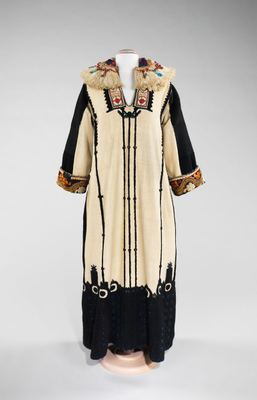
In the pictureThis is a long dress shown on a mannequin. Several vertical rows of black cord are applied to the ivory wool ground, and the backs of the sleeves are black cloth from the shoulder down. Around the neck is a wide collar thick with beige tassels mixed with red, purple and teal pompoms and beads, and on either side of the front of the neck are square ornaments embroidered with red circles. The turned-back cuffs have orange and yellow flower embroidery on black, and the hem is bordered in black with a small blue pattern and white loop motifs. Above the hem band, black tower-shaped motifs rise to interlock with the ivory ground.
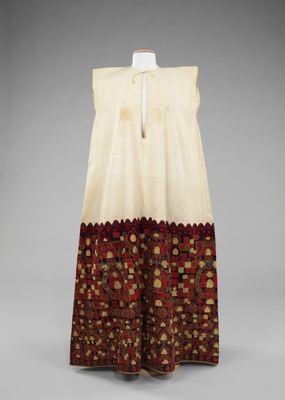
BackgroundAccording to the record, the materials are cotton and wool, the length at center back is 139.7 cm, and the date is late 19th century. Placing black line trim on an ivory ground and concentrating color at the collar and cuffs is a practice seen in women's clothing of the Balkans and Eastern Europe, and the tassels and pompoms of the wide collar suggest it was worn at festivals. The collection record does not name a region. Unlike the sleeveless linen dress in the same ivory tones that has embroidery only at the hem, this one has long sleeves and color scattered from top to bottom. George Vincent gave it to the Brooklyn Museum in 1950. It was transferred to the Met in 2009.
Puzzle tipThe color is concentrated at the collar, cuffs and hem, so fit those three areas first. The white loop motifs of the hem and the rising black tower-shaped border are the guides for the bottom. On the ivory body, tell the center from the sides by the spacing and width of the black vertical lines, and fix the sleeves with the black cloth of the arms. The tassels of the collar fan outward, so check their direction as you place them. The gray background comes last. 48 pieces work well.
- Classification
- Main dress-Womenswear
- Medium
- cotton, wool
- Dimensions
- 139.7 cm
- Credit line
- Brooklyn Museum Costume Collection at The Metropolitan Museum of Art, Gift of the Brooklyn Museum, 2009; Gift of George Vincent, 1950
Source: The Metropolitan Museum of Art ↗
Stories about this work
- From Headscarf to Apron: Five Layered European Women's Folk Costumes
Headscarves, vests, striped skirts and aprons. Nineteenth-century European women's folk dress assembled from separate parts, plus a jacket and dress photographed together in one picture.
Puzzles to try next
More European Embroidery & Costume puzzles· Stories and puzzle tips