From 1735 to 1823: Five Signed Embroidered Samplers and One Building
Published
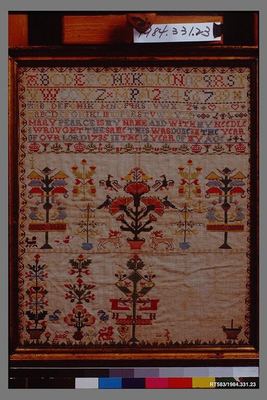
“Mary Pearce made this with her needle.” The girl who stitched these words beneath rows of the alphabet on linen was about thirteen. Earlier, in The story of the embroidered sampler, we looked at three samplers; this time, six that were not covered then are laid out in chronological order. They span almost 90 years, from 1735 to 1823. Five carry the maker’s name, and even where no age is stitched, for some you can work back to roughly how old the maker was from the birth year in the museum record. Only the last of the six stitched a building instead of a name.
| Work | Maker | Year |
|---|---|---|
| Embroidered sampler | Mary Pearce | 1735 |
| Embroidered sampler of the Queen’s House, Greenwich | Unknown artist | 1777 |
| Embroidered sampler | Rebecca Gallyon | 1792 |
| Embroidered sampler | Jane Rogers | 1800–1830 |
| Embroidered sampler | Mary Ann Reed | 1813 |
| Embroidered sampler | Harriott Cates | 1823 |
1735: Mary Pearce, age thirteen
 Solve this painting as a puzzle → about 5 minutes on Easy
The oldest is Mary Pearce’s sampler. She stitched several rows of the alphabet on linen in red and brown thread, and beneath them added a line saying she made it with her needle. The museum record gives her birth year as around 1722, so she completed it at about thirteen. Eighteenth-century English girls left behind their first real works this way, by stitching their own names. Compare it with the band sampler made in 1727 by fourteen-year-old Mary Griffiths, and you can see how much more space pictures came to take up within just a few years.
The rows of letters and the picture area are separated by red bands, so as a puzzle, assemble the band pieces first and place the tree and bird pieces below them.
1777: a building instead of a name
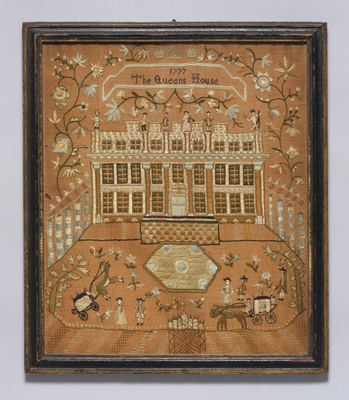
The Embroidered sampler of the Queen’s House, Greenwich is the odd one out in this list. With no alphabet or verse, it stitches a real building like a picture. On a brown ground fabric, a building with rows of white windows stands facing front, and above it are the words “The Queens House 1777.” Below, a garden, a carriage, and people out for a stroll are placed in miniature.
The Queen’s House is a royal residence in Greenwich designed by the architect Inigo Jones in the early 17th century, and it is regarded as the first classical building in England. The maker’s name has not survived. Still, given that even the number of windows and the roof ornaments match, it must have been made with the building itself or a print in front of the maker.
The white grid of the building’s windows, the small people and carriage in the garden below, and the vine borders on both sides divide the picture into three zones. The windows are so regular that they are confusing, so use the roof and the ground-floor door as reference points and count the floors.
1792: four verses of a hymn and a flock of sheep
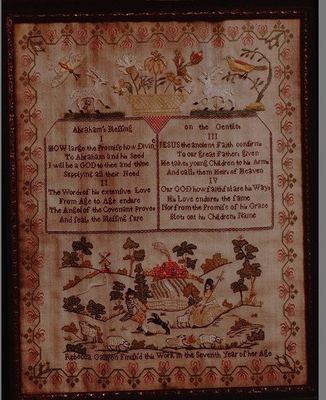
Rebecca Gallyon’s sampler holds four verses of a hymn about the blessing of Abraham together with a landscape where a flock of sheep grazes. Inside a red floral border, two panels sit side by side with two verses each, and below them spreads a landscape with trees, sheep, a dog, and a seated figure. It was a hymn widely sung in 18th-century England. Putting the words into a sampler allowed needlework and religious instruction to happen at the same time. Rebecca Gallyon stitched her own age as well, so we know it is the work of a young girl.
Work in by dividing it into the text panels at the top, the landscape below, and the outer border.
1800–1830: embroidery grows more colorful
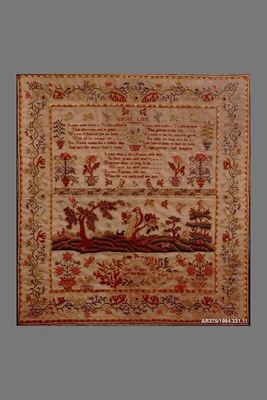
Jane Rogers’s sampler is recorded not with an exact year but only with a 30-year range. A double border of red flowering vines encloses the picture, and inside are a few lines of verse, a basket of flowers, two birds, trees, and a small house. In early 19th-century English samplers, this format, with a double border and the inside filled with pictures, became established. Red, green, brown, and yellow are evenly mixed, making it noticeably brighter than the previous two.
It has many colors and few blank fabric pieces, so it is enjoyable even at Expert (about 300 pieces).
1813: a verse about saving time
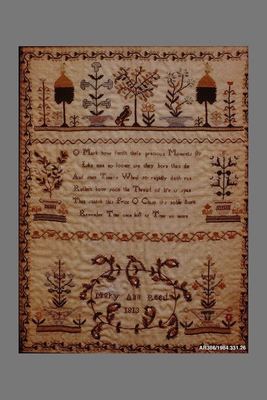
Mary Ann Reed’s sampler holds a moral verse that begins, “See how swiftly the precious moments pass.” Verses like this, urging the reader not to waste time, were often stitched into samplers. It is divided horizontally: three trees and birds at the top, eight lines of verse in the middle, and at the bottom the name and year wrapped in a flowering vine. Finishing with the name encircled by a flowering vine was fashionable in English samplers of the 1810s.
1823: Harriott Cates, age six
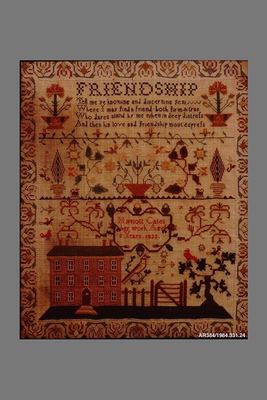
The last is Harriott Cates’s sampler. Inside a red floral border, she stitched the large word “FRIENDSHIP” and a few lines of verse at the top, a flower basket, birds, and trees in the middle, and a red brick house and fence at the bottom. Judging by the birth year in the museum record (around 1817), she made it at about six. Houses like this were often not the girl’s own home but a set design from a pattern book, and girls made them their own by changing the number of windows or the color of the door. Verses celebrating friendship often appear on samplers stitched as gifts for school friends.
The samplers of Mary Ann Reed and Harriott Cates are both divided horizontally into three zones, top (trees), middle (verse), and bottom (name or house), so fill in the top and bottom bands first. For most of these, including those two, Hard (about 100 pieces) is a good fit.
From alphabet to picture, and one exception
Lay the six out in order, and you can see how English samplers gradually moved from alphabet practice toward a form closer to a picture. It begins with the plain alphabet rows of thirteen-year-old Mary Pearce and arrives at a cloth on which six-year-old Harriott Cates included a title, a verse, and even a picture of a house. Yet the 1777 Queen’s House, sitting right in the middle of that progression, alone has no name. Some left their names; someone left a building.
Among museum collections, where works by an unknown artist far outnumber the rest, the samplers of girls learning needlework are a rare case where names have clearly survived. Set them beside garments whose makers are entirely unknown, like the Hungarian shepherds’ winter coats, and you can guess what a big thing it must have been for girls of that time to stitch their own names, one stitch at a time, into the corner of a cloth.