Ginevra de' Benci
A pale Florentine woman sits before a spiky juniper bush. It is the only painting by Leonardo da Vinci in the Americas. Full commentary ↓
Couldn't load the puzzle image.
Turn on piece outlines to see piece positions on this picture too
Drag the pieces into place · When zoomed in, drag an empty spot to move around
You can also play with a keyboard — Tab to the board, thenSpace pick a piece, Arrow keys move it (with Shift for small steps),Esc deselect, R rotate a piece (Shift+R the other way)
Ginevra de' Benci is an oil painting by Leonardo da Vinci (ca. 1474/1478) in the collection of National Gallery of Art. It measures 38.1 × 37 cm.
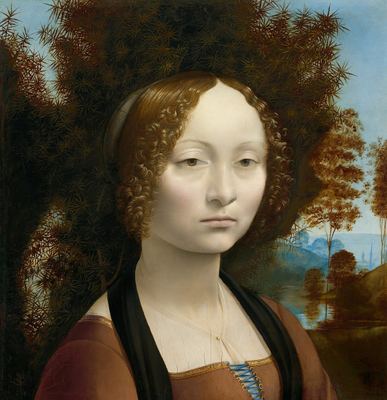
In the pictureA young woman sits with her body turned to the right and her face turned almost to the front. Her skin is pale and smooth, and her brown eyes, under heavy lids, seem to look at us and past us at once. Her brown hair, parted in the middle, falls in small curls on either side of her face. Behind her head a dark juniper bush with needles radiating like stars covers almost the whole upper part of the picture; only on the right does a gap open to show a river under a blue sky, trees turned brown, and a slender spire in the distance. At the bodice of her brown dress a blue lace is laced crosswise, and over it lie a thin white cloth and a black shawl.
BackgroundLeonardo painted this portrait in Florence in the 1470s, when he was in his twenties, and it is the earliest of his portraits of women. The sitter, Ginevra de' Benci, was the daughter of a wealthy Florentine banking family, and the portrait is said to have been painted around the time of her marriage at about sixteen. The juniper behind her, ginepro in Italian, is a play on her name. The back of the panel is also painted, with a laurel and a palm branch encircling a sprig of juniper. Part of the bottom was cut away, and it is thought that her hands were originally shown. The National Gallery of Art in Washington bought it from the Princes of Liechtenstein in 1967.
Puzzle tipStart with the brightest areas, the face and the white chest, to set the center. Below the face come the blue lacing and the gold-edged bodice, and the river and blue hills at the lower right, distinct in color, make a good next step. The hard part is the bush behind her head. The star-shaped leaves repeat the same pattern, so find positions using the patches of sky blue that show here and there along the top edge and the brown that grows redder toward the right. 100 pieces is a good fit.
- Classification
- Painting
- Medium
- Oil on panel
- Dimensions
- 38.1 × 37 cm
- Credit line
- National Gallery of Art, 1967.6.1.a
Source: National Gallery of Art ↗
In these collections: Masterpieces Everyone Knows · Portrait and Self-Portrait Puzzles