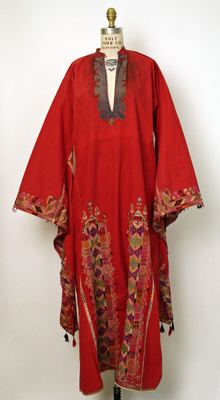
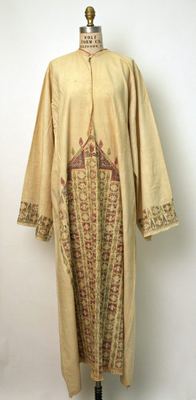
Group of Syrian Garments with Festive Dress, Abaya, Agal Headcord, and Two Headscarfs
A Syrian festive dress of cream linen with a floral grid embroidery panel and a stepped triangular top, part of a set with a cloak, headcord, and headscarves. Full commentary ↓
Couldn't load the puzzle image.
Turn on piece outlines to see piece positions on this picture too
Drag the pieces into place · When zoomed in, drag an empty spot to move around
You can also play with a keyboard — Tab to the board, thenSpace pick a piece, Arrow keys move it (with Shift for small steps),Esc deselect, R rotate a piece (Shift+R the other way)
Group of Syrian Garments with Festive Dress, Abaya, Agal Headcord, and Two Headscarfs is a textile by an unknown maker (late 19th–early 20th century) in the collection of The Metropolitan Museum of Art.
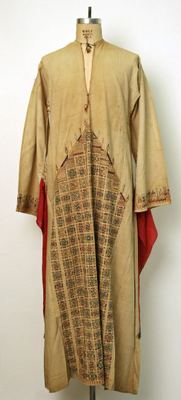
In the pictureOnly the dress (a) from the set is shown on the mannequin in the photograph. On the cream linen ground, the narrow vertical neck slit is edged in red thread and fastened with a tasseled cord. From waist height to the hem, the center front is filled with a grid of small square floral motifs, topped by a triangle that narrows in steps and finished with small tree-shaped motifs rising from it. The ends of the long sleeves have bands of embroidered flowering sprigs, and long strips of red cloth hang down both sides, ending in small tassels. There are stains on the chest and shoulders.
BackgroundAccording to the Met's record, this group has five pieces: the dress (142.2cm high), the abaya cloak (135.9cm), two kufiya headscarves (228cm and 165.1cm), and the agal headcord, 21.6cm wide. The festive dress is attributed to the Qalamoun region and the rest to Aleppo or Damascus, so garments of different origins are gathered in one set. Irene Lewisohn and Alice Lewisohn Crowley gave it in 1939. The arrangement drawing the top of the front embroidery panel to a point can also be seen in this site's Qalamoun festive dress (86249).
Puzzle tipOn the cream ground, the front embroidery panel forms a distinct vertical band. Using the apex piece of the stepped triangle as a reference, work the grid downward one square at a time, and fix the top and sides with the tasseled cord at the neck slit and the flowering-sprig bands at the two cuffs. The two red strips at the sides are vivid in color and immediately show the left and right edges. The stains on the chest and shoulders can be used to tell cream pieces apart. 100 pieces is a good fit.
- Classification
- Main dress
- Medium
- Linen, silk, metal wrapped thread; plain weave, embroidered
- Dimensions
- Underrobe (a):
- Credit line
- Gift of Irene Lewisohn and Alice Lewisohn Crowley, 1939
Source: The Metropolitan Museum of Art ↗
Stories about this work
- Syrian Festive Dresses and Albanian Wedding Ensembles Whose Embroidery Names the Village
Festive dresses from Quteife, north of Damascus, and the mountainous Qalamun region are told apart by their embroidery. Add two gold-thread wedding ensembles from Albanian towns, and we assemble five garments from the Met's Islamic Art department as puzzles.