Syrian Festive Dresses and Albanian Wedding Ensembles Whose Embroidery Names the Village
Published · updated
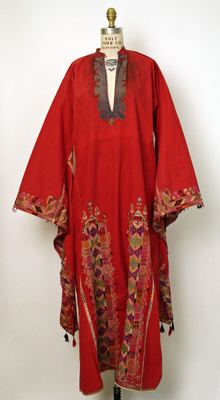
The red dress has embroidered panels on both sides of the hem, and the cream dress gathers its front embroidery into a point like a roof. That difference is the difference between two villages. The Islamic Art category has three sets of clothing that Syrian women actually wore: festive dresses from two villages, and a set that includes an entire festive outfit. To these we added two Albanian wedding ensembles held by the same department. The Syrian clothes are mostly from the early 20th century, the Albanian wedding ensembles from the late 19th century. The materials are cotton, silk, and linen, and metal thread is mixed into the embroidery.
| Work | Date and place | Materials | Acquisition |
|---|---|---|---|
| Festive Dress from Quteife | Around the early 20th century | Cotton, silk, embroidery | Irene Lewisohn Bequest, 1969 |
| Festive Dress from Qalamun | Probably early 20th century | Cotton, silk, metal thread, embroidery | Gift of Clara Sobernheim, 1952 |
| Group of Syrian Garments | Late 19th–early 20th century | Linen, silk, metal thread, embroidery | Gift of Lewisohn and Crowley, 1939 |
| Wedding ensemble (red) | Late 19th century, Tirana, Durrës, and Kavajë, Albania | Silk, cotton, metal thread | Gift of Burta May Taylor, 1988 |
| Wedding ensemble (black) | Late 19th century, Elbasan, Albania | Silk, cotton, metal thread | Gift of Burta May Taylor, 1988 |
Telling villages apart by embroidery
 Solve this painting as a puzzle → about 5 minutes on Easy
The Festive Dress from Quteife has a red cotton ground. There is a dark embroidered panel around the neck, embroidered panels with lozenges and floral patterns are attached on both sides of the hem, and the sleeve ends hang down to a point. Quteife is a village north of Damascus. Women’s festive dress in this area is said to have identified the village by its red ground and the embroidery on the hem and sleeves. The pointed sleeves were made to swing when dancing, and for ordinary walking the sleeve ends were tied up behind.
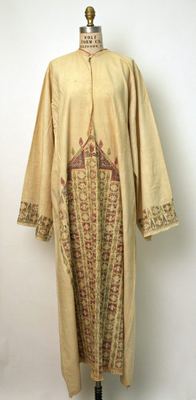
The Festive Dress from Qalamun has a cream cotton ground. An embroidered panel running from below the chest to the hem gathers into a pointed triangle as it rises. Qalamun is a mountainous region between Damascus and Homs, and its festive dress is said to be distinguished by finishing the front embroidered panel in a point like a roof.
Stand the two side by side and the difference is clear at a glance. Quteife placed its embroidery on both sides of the hem, Qalamun across the whole front in the shape of a roof. The ground color and the placement of the embroidery alone are enough to tell the two villages apart.
In the puzzle, too, the boundaries of the embroidered panels are the starting point. Assemble the boundaries first and the picture divides into a few zones. On the Qalamun dress, the piece at the apex of the triangle that narrows as it rises is the only such spot in the picture, so it makes a sure reference point.
A festive outfit complete down to the head
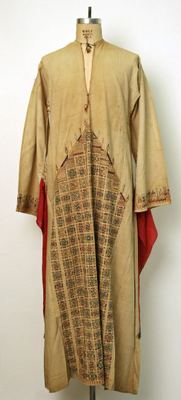
Group of Syrian Garments is not a single dress. Several garments are held as one set, and the very title in the museum records is “Group of Syrian Garments with Festive Dress, Abaya, Agal Headcord, and Two Headscarfs.”
Because the dress, the outer robe (abaya), the cord that holds the head covering in place (agal), and two headscarves are kept together, we can see how Syrian women actually dressed for festivals. Things you would miss looking only at the dress, namely what was worn over it and how the head was wrapped, are all contained in this one entry. The pattern of the grid-patterned embroidered panel on the front varied by region, and linen is said to have been a traditional material of Syrian textiles.
With several garments layered, start by dividing broadly by material and color when you assemble it: the triangular embroidered panel of the dress, the red cloth of the outer robe, the headscarves. Fill in the details after that.
Albanian wedding ensembles embroidered in gold thread
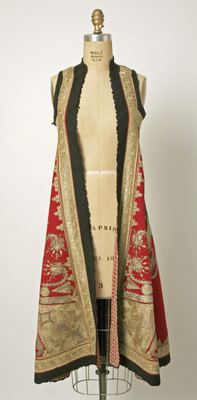
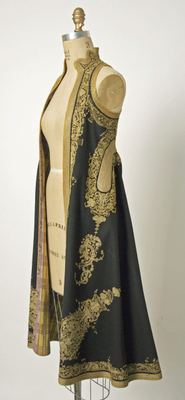
The red wedding ensemble and the black wedding ensemble are both long sleeveless outer garments, embroidered in metal thread with flowers, leaves, and scrolling vines. Their lengths, 116 centimeters and 114 centimeters, are almost the same.
They are shown with the Syrian clothes, but according to the Met’s records both were made in Albania. The red one is recorded as from Tirana, Durrës, and Kavajë, the black one from Elbasan, so they come from different towns. They entered the collection in 1988 from the same donor. Albania was part of the Ottoman Empire until the early 20th century, which appears to be why these garments are in the Islamic Art department. According to the collection records, neither is just an outer garment; each is an ensemble of several parts (seven for the red, six for the black), and the photographs show the long outer garment among them.
On the red garment, the pattern covers the entire ground densely. The black garment concentrates its pattern only on the front opening, the hem, and the edges of the side seams. Thread wrapped with metal is heavy and stiff, so it is said to have often been concentrated on the edges rather than used over the whole garment, which means far more material and labor went into the red one.
Why put so much effort into clothes like these? Metal-thread embroidery took costly materials and much labor, so it is said to have been concentrated in clothes for once-in-a-lifetime occasions like weddings. Mothers passed them down to their daughters or made them as part of a trousseau, and how dense the pattern was and how much gold thread was used revealed the family’s means directly.
The two wedding ensembles are assembled in opposite ways. On the red one, the entire ground is pattern, so the pieces resemble one another. As discussed in why repeating patterns are hard, it is better to use shape clues, such as the outline of the mannequin or the shadows of the folds, before the pattern. On the black one, the pattern is concentrated on the borders, so gather the border pieces first and fill in the plain black body later.
All five are garments dressed on mannequins, so their outlines are clear. For piece counts, we recommend 48 to 100 pieces for the two dresses and the two wedding ensembles, and 100 pieces for the set of layered garments.
A map drawn with a needle
Seen together, the five garments unfold a map drawn in embroidery: Quteife north of Damascus, the mountainous Qalamun region, and across the sea, the wedding customs of towns in central Albania. The same holds when you set them beside Indian men’s robes or the story of an embroidered sampler. Needle and thread recorded hometown, means, and celebration on clothing in astonishing detail. It was a time when, before the wearer said a word, the clothes said where that person came from.