Head of a Bishop with Crozier
The face of a bishop in a miter holding a crozier, only 3 cm high in reality: a small 15th-century French limestone piece with traces of gilding. Full commentary ↓
Couldn't load the puzzle image.
Turn on piece outlines to see piece positions on this picture too
Drag the pieces into place · When zoomed in, drag an empty spot to move around
You can also play with a keyboard — Tab to the board, thenSpace pick a piece, Arrow keys move it (with Shift for small steps),Esc deselect, R rotate a piece (Shift+R the other way)
Head of a Bishop with Crozier is a stone object by an unknown maker (15th century) in the collection of The Metropolitan Museum of Art. It measures 3.1 × 2.7 cm.
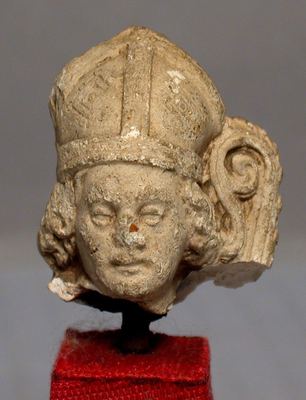
In the pictureA small head set on a red stand. It wears a pointed miter, the scrolled head of a staff shows beside the right shoulder, and curly hair, eyes, nose and mouth are carved. There are traces of gilding on the surface, and its actual height is just over 3 cm.
BackgroundThe miter and the scrolled staff (crozier) are the marks of a bishop, which tells us this small head was part of a statue of a bishop. In 15th-century France, several saints' figures of this size were grouped together to decorate small altars or reliquaries, and they were originally finished with paint and gilding. The body is lost and only the head remains, but because the head of the staff is attached, its identity can still be known.
Puzzle tipThe gray background and the pale stone separate, so the outline pieces are the key. The pointed top of the miter, the scroll of the staff and the red stand below have clear shapes and are good to fit first. Place the plain pieces of the face using the shadows of the eyes and mouth. 24 pieces is about right.
- Culture
- French
- Classification
- Sculpture-Stone
- Medium
- Limestone, traces of gilding
- Dimensions
- 3.1 × 2.7 cm
- Credit line
- Bequest of Nanette B. Kelekian, 2020
Source: The Metropolitan Museum of Art ↗
Stories about this work
- Reading the Lost Color in Four Medieval Sculptures
These sculptures, which now look like white stone or brown wood, were originally brightly painted. What can we read in the places where the color has vanished?