Reading the Lost Color in Four Medieval Sculptures
Published
Read museum labels for medieval sculpture and the same phrase keeps turning up: “originally finished with paint and gilding.” Even though what is in front of you is white stone or the color of bare wood. From “Medieval Art,” we gathered four pieces in which only traces of that vanished color remain.
| Work | Material | Size | Period |
|---|---|---|---|
| Head of a Bishop with Crozier | Limestone, traces of gilding | 3.1 × 2.7cm | 15th-century France |
| Saint Barbara | Caen stone, originally painted and gilded | 141.9cm | 16th-century France |
| Altar Shrine with Four Saints | Oil, gold leaf, wood | 125.1cm | Late 15th-century Venice |
| Panel (linenfold) | Oak | 51.8cm | 16th-century Europe |
A bishop the size of a fingernail
 Solve this painting as a puzzle → about 5 minutes on Easy
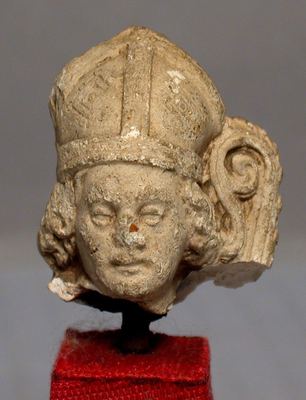
Head of a Bishop with Crozier is only 3 centimeters in actual size. The miter and the spiral-headed staff (the crozier) are a bishop’s insignia, so from this small head alone you can tell it was originally part of a statue of a bishop.
The body is gone and only the head remains. In 15th-century France, several saint figures of this size were gathered to decorate a small altar or reliquary, and the finishing was paint and gilding. The gilding that faintly remains on the surface tells us that this small face once glittered.
In the puzzle, the gray background and the light stone separate clearly, so once you have the outline you are nearly done. Start with pieces whose shapes are distinct, such as the pointed top of the miter, the spiral of the staff, and the red base below. 24 pieces is enough.
The colorless robe of a saint holding a tower
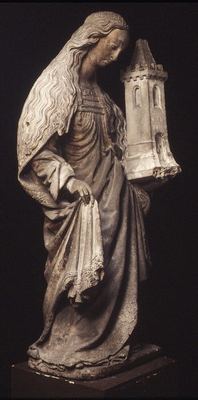
Saint Barbara is a large stone statue 1.4 meters tall. In legend, Barbara was martyred after her father locked her in a tower, and so the tower became her emblem. Believed to protect against lightning and sudden death, she was also venerated as the patron saint of miners and artillerymen.
This sculpture, too, was splendid at first. The white limestone of the Caen region was easy to carve and widely used for cathedral sculpture in northern France, and once carving was finished, paint and gilding were applied. The faint traces of paint left on the surface suggest that the white stone we see now is only part of its original appearance.
The black background and the white statue divide sharply, so here too run the outline first. Then assemble the face, the model tower, and the hanging hair, and connect the folds of the robe by following the direction of the shadows. The picture is tall and narrow, so working from top to bottom is easier. We recommend 48 pieces.
Open the doors and there is a golden Virgin
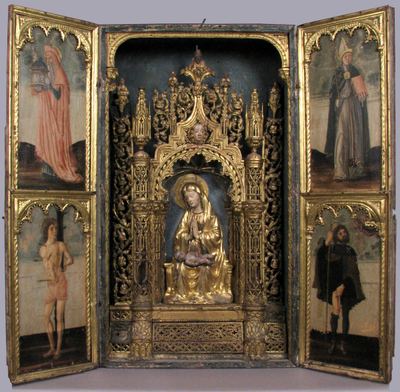
Altar Shrine with Four Saints is a rare example in which the paint survives intact. Inside a wooden altar with both doors opened stands a golden statue of the Virgin, and four saints are painted on the inner sides of the doors.
It is a small altar that would have been kept in the bedroom or private chapel of a wealthy household, its doors opened and closed for prayer. Now that the first two sculptures have lost their color, this altar lets you gauge what kind of impression gilding and oil paint originally gave. Sculpture, painting, and architectural ornament are all contained in a single object.
The straight edges and the compartments of the doors naturally form a frame. Assemble the golden Virgin and canopy in the center first, then fill in the doors while watching the colors of the four saints’ robes. 100 pieces is right.
A panel that never had color
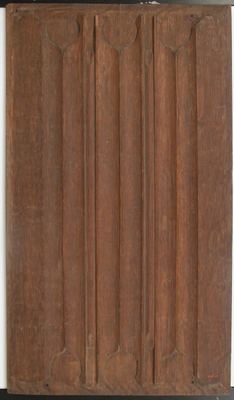
The linenfold Panel is a different kind of object. Vertical grooves in the shape of folded cloth are carved into an oak panel that was never painted in the first place.
This pattern, called “linenfold” (folded linen), was widely used in 15th- and 16th-century northern Europe to decorate chests, doors, and wall paneling. It transfers the shape of cloth folded and stood upright onto wood; it was easy to make, yet its shadows change with the light, so covering a whole wall with it looks rich. It is decoration made with light and shadow alone, without color, a panel that holds up on its wood grain alone.
It is one of the hardest to assemble. It is nearly a single color, so start with the rounded finishing pieces at the top and bottom ends, then connect along the shadow lines made by the vertical grooves. The only clues are tiny differences in the wood grain, so we recommend starting with 24 pieces.
The illusion of a plain Middle Ages
After seeing the four together, the way you look at medieval sculpture changes. The white stone and brown wood in museums are usually the result of time stripping away the paint. Some sculptures, like the Mourning Virgin, were never painted, but three of the four gathered here originally wore bright colors. The “plain Middle Ages” we picture may be an illusion created by time.
More medieval objects of similar size can be found in Small treasures of the Middle Ages and Medieval everyday objects, and paintings whose gilding survives intact can be seen in the Gold panel painting puzzle guide.
Look long at a sculpture whose color has vanished and you keep picturing what is no longer there. A single spot of gold left on the bishop’s face, the faint paint soaked into the hem of Barbara’s robe. Those small traces point toward how they originally looked.