Panel with Lovers
A 5 cm bone carving of two figures embracing body to body: part of a box decoration from Egypt in the late Roman to early Byzantine period. Full commentary ↓
Couldn't load the puzzle image.
Turn on piece outlines to see piece positions on this picture too
Drag the pieces into place · When zoomed in, drag an empty spot to move around
You can also play with a keyboard — Tab to the board, thenSpace pick a piece, Arrow keys move it (with Shift for small steps),Esc deselect, R rotate a piece (Shift+R the other way)
Panel with Lovers is an ivory or bone object by an unknown maker (4th–6th century) in the collection of The Metropolitan Museum of Art. It measures 5 × 4.5 cm.
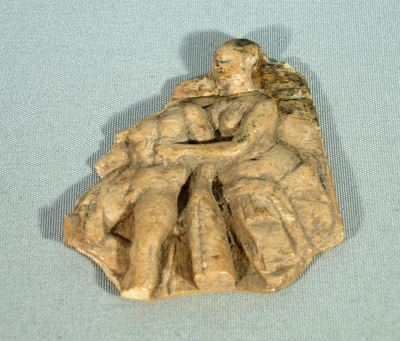
In the pictureA single yellowish piece of bone lies on blue-gray fabric. The upper figure, long hair falling back and upper body bare, wraps one arm around the figure on the left, and the two lean at a slant, bodies pressed together. The head of the left figure is worn and indistinct, and below it straight legs and deeply cut drapery folds can be seen. Behind the two is a slanted surface that looks like a couch or backrest. A dark stain has soaked into the upper right corner, the edges are broken all around into an irregular shape, and the relief is deep enough to cast dark shadows on the fabric.
BackgroundThe Met's record classifies this piece as a bone fragment from Egypt in the late Roman to early Byzantine period (4th–6th century). Bone panels like this were decorations attached to the surfaces of wooden boxes or furniture, carved from thin slices of animal bone, which was easier to obtain than ivory. Some suggest that panels showing lovers or mythological couples were attached to boxes given as wedding gifts, but the record does not say where this piece was originally attached. It is one of the objects that came to the museum in 2020 as a bequest of Nanette Kelekian.
Puzzle tipThe yellowish bone and the blue-gray fabric separate clearly, so ringing the broken outline with its pieces first gives you the shape. Place the curved pieces of the upper figure's face, chest and embracing arm inside, and join the lower part using the vertical grooves of the legs and drapery. Along the outline, the long diagonal at lower left and the straight vertical edge on the right set the orientation, and the dark stain at upper right is another good marker. Fill in the shadowed fabric pieces last. 24 pieces is about right.
- Culture
- Late Roman/Early Byzantine
- Classification
- Ivories-Bone
- Medium
- Bone
- Dimensions
- 5 × 4.5 cm
- Credit line
- Bequest of Nanette B. Kelekian, 2020
Source: The Metropolitan Museum of Art ↗
Stories about this work
- A Thousand Years From One Collector: Five Objects From the Kelekian Bequest
From 6th-century Byzantine ivory to 16th-century Flemish boxwood carving. Crossing a thousand years with five objects one collector left to the museum in 2020.