'If he is guilty, let him die quickly' (Si es delinquente qe. muera presto)
A prisoner slumped at an angle in an iron collar with shackles on his ankles: Goya's prison print Si es delinquente qe. muera presto. Full commentary ↓
Couldn't load the puzzle image.
Turn on piece outlines to see piece positions on this picture too
Drag the pieces into place · When zoomed in, drag an empty spot to move around
You can also play with a keyboard — Tab to the board, thenSpace pick a piece, Arrow keys move it (with Shift for small steps),Esc deselect, R rotate a piece (Shift+R the other way)
'If he is guilty, let him die quickly' (Si es delinquente qe. muera presto) is a print by Goya (ca. 1815 (published 1859)) in the collection of The Metropolitan Museum of Art. It measures 11.6 × 8.5 cm.
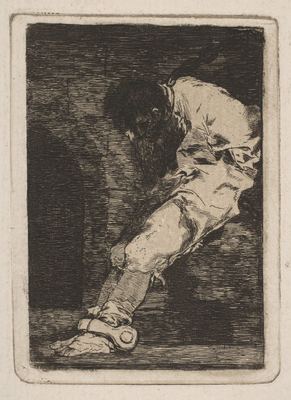
In the pictureIn a dark cell, a man leans his body at an angle from upper right to lower left, his legs stretched out. An iron collar is fastened around his neck with a chain running up into the darkness above, and heavy shackles with round bolts are fitted to his outstretched ankles. His head is bowed, so most of his bearded face is buried in shadow. At the back left, the dark curve of an arched wall can be seen, and the background is blackened with closely engraved horizontal lines. The marks of the plate's four rounded corners and the light band of the plate border remain intact.
BackgroundThe title means "If he is guilty, let him die quickly," read as a paradox: a quick execution would be better than the suffering of being held in chains for a long time without a verdict. It is a prison print made around the same time as The Custody Is as Barbarous as the Crime, and neither shows the prisoner's face clearly. Where that one shows a huddled body with both arms bound, this one shows a body hanging slack with neck and feet caught in iron. The only technique is etching, the plate measures 11.6×8.5cm, and according to the Met's record it was printed in 1859. It was acquired through the Rogers Fund in 1918.
Puzzle tipThe light shirt and trousers form a long diagonal from upper right to lower left. Joining this diagonal first sets the direction of the picture. Next come the round bolts of the shackles and the bare feet at lower left, and the collar and chain at upper right. The arch shadow on the left is darker than the other black areas and can be gathered separately, and the light band of the plate border marks the outer edge. The plate is small, so 24 pieces is recommended.
- Artist
- Spanish, Fuendetodos 1746–1828 Bordeaux
- Classification
- Prints
- Medium
- Etching
- Dimensions
- 11.6 × 8.5 cm
- Credit line
- Rogers Fund, 1918
Source: The Metropolitan Museum of Art ↗
Stories about this work
- The Prison Prints and Cruel Spectacle Goya Never Released in His Lifetime
Not the bullfight prints, and not Los Caprichos. Two prison prints and a cruel spectacle that came out only after Goya's death, plus one nightmare from his last years.