The Prison Prints and Cruel Spectacle Goya Never Released in His Lifetime
Published · updated
A prisoner with both arms chained to a wall hangs his head. In the print beside it, a black bull lifts a blind guitarist on its horns. Goya made pictures like these and never released them during his lifetime.
Two of Goya’s series have been covered separately already. The bullfight prints took on the skill and tension of the bullring, and Los Caprichos took aim at society’s hypocrisy and superstition. The four works gathered here belong to neither. They are two prisoners in jail, a blind musician turned into a cruel spectacle, and one nightmare from his last years.
| Work | Date | Medium | Size |
|---|---|---|---|
| The custody is as barbarous as the crime | ca. 1815 (printed after 1867) | Etching, burin | 11 × 8.8 cm |
| If he is guilty, let him die quickly | ca. 1815 (printed 1859) | Etching | 11.6 × 8.5 cm |
| Barbarous Entertainment | 1800–1804 (printed 1828–67) | Etching, aquatint, drypoint | 17.7 × 21.9 cm |
| Nightmare | ca. 1819–23 | Brush, ink, wash | 23.4 × 14.4 cm |
Faceless prisoners
 Solve this painting as a puzzle → about 5 minutes on Easy
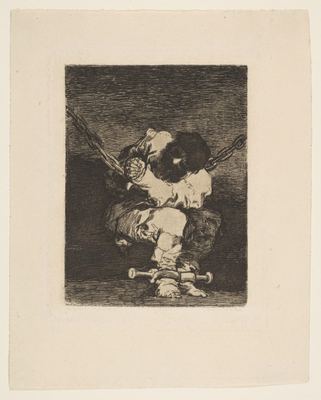
The custody is as barbarous as the crime is a small print of a prisoner whose arms are chained to the wall and whose feet are in shackles. Around 1815, Goya made three small etchings of prisoners. Each carried a title such as “The custody is as barbarous as the crime” or “If he is guilty, let him die quickly,” jabbing at the penal system.
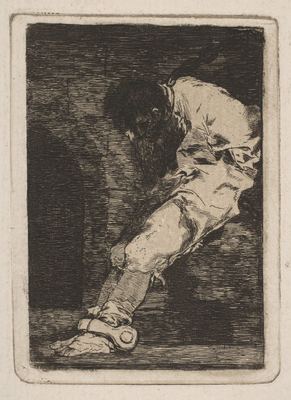
If he is guilty, let him die quickly is another sheet from the same series. An iron collar is fastened around the prisoner’s neck, with a chain running up into the darkness above, and a heavy iron fetter with a round bolt is fixed on the ankles he stretches out in front of him. He bows his head deeply. The title carries an inverted plea: better a quick execution than confinement close to torture.
Neither print shows the prisoner’s face. In these three prison prints of the same size, Goya conveys suffering through the posture of the body alone. With the face hidden, who the prisoner is stops mattering, and what remains is the cruelty of the penal system itself. Both were not published during his lifetime and were printed later; in terms of timing, they belong to the same dark vision as The Disasters of War.
As a puzzle, the white shirt in the dark background is the only bright spot. Use these pieces to fix the figure’s position first, and start from there. These are small prints around 12 centimeters tall, so 24 pieces is about right.
Spectators laughing as a person is hurt
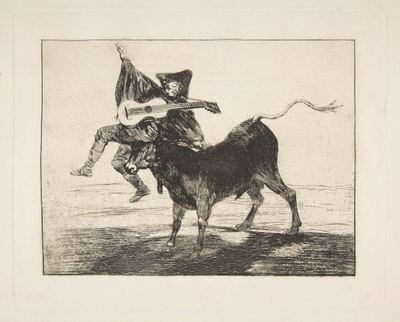
Barbarous Entertainment hides nothing, starting with its title. A black bull lifts a blind guitarist on its horns. Goya was denouncing an amusement in which blind street musicians were put in the bullring to be gored by bulls.
Just because a bull appears, it should not be lumped in with the Tauromaquia series depicting bullfighting technique. This print was made between Los Caprichos and the Tauromaquia, and it was printed only after his death. The subject may be similar, but the target is entirely different. If the Tauromaquia recorded the bullfighter’s skill and courage, this print is aimed at a society that laughs while the weak are hurt. That anger is carried intact in the black mass of the bull and the helpless posture of the musician.
The black bull and the pale gray background separate clearly, so put together the bull’s outline first and find the musician floating in the air within it. 48 pieces is about right.
The nightmare of an old painter who had lost his hearing
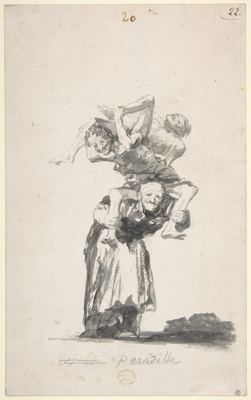
Nightmare is not a print but a drawing made with brush and ink. An old woman carrying two people on her back struggles along. From around 1819, having lost his hearing, Goya made brush drawings in albums at the “House of the Deaf Man” near Madrid, and this drawing comes from that time.
The scene of an old woman walking with young people on her back is read as the burdens generations place on each other, or as a nightmarish reality. Instead of fine engraving like a print, the tonal shading of ink laid down quickly with a brush remains fully alive. It is an image from the final period, drawn by an aging painter alone, unable even to hear.
In the puzzle, too, this shading is the key. Separate the dark brushstrokes from the light ones first, and the figures’ outlines emerge. I recommend 48 pieces for this one as well. All four works are dark, dense images, so the density-sorting method used in the Degas and Lautrec drawings and Goya’s Los Caprichos works just as well.
Why did he not release them?
None of the four works appeared during Goya’s lifetime. The two prison prints were printed only in 1859 and after 1867 respectively, and Barbarous Entertainment was printed between 1828 and 1867. Nightmare was never a print to begin with but a drawing in a private album. It may have been because of Spain’s political situation or censorship, or the darkness of the subjects themselves, but the exact reason cannot be confirmed from the information on this site.
One thing is clear. Goya left his darkest thoughts in pictures with no intention of showing them to anyone. In Los Caprichos he mocked hypocrisy, and in the Tauromaquia he recorded the skill of bullfighting, but what remains in these four works is an anger close to silence. Now we are putting together, piece by piece, pictures he never even meant to publish. It makes you wonder what expression Goya would have made if he heard.